
The History Of Pilot Aviator Sunglasses
Pilot Aviator sunglasses are one of the most sought after, trendy and important fashion accessories to have for everyday use. But, more importantly, pilot sunglasses have become an essential tool for pilots to carry in their kits. Pilot aviator sunglasses that protect their eyes are one of the most essential items they carry. It became very clear how important sunglasses would be early on after the first manned aircraft flight by the Wright Brothers back in 1903. Soon thereafter a rush began to build, fly, and invent new and newer aircraft that were capable of doing more than just taking people up for airplane rides.
Soon, pilots discovered that as they flew their airplanes, their eyes encountered unexpected problems. For example, early aircraft engines spat out a lot of oil, which in turn, flew back into the eyes of the pilot. That is why when you see photographs of early aviators they are wearing those flowing white scarfs around their neck - they needed them to clean the oil off of the lenses in their goggles. As airplanes became capable of flying higher, pilots noticed the effect of the strong light rays emanating from the sun. They needed to find a way to protect their most important sensory asset - their eyes.
But where did sunglasses come from? Lets take a trip back in time and discover how sunglasses were first used, and how they evolved over time. After all, sunglasses are not just for pilots. We see them everywhere, whether on pilots in the cockpit when we make a flight on the airlines, or watch one of our favorite actors or actresses walkling the red carpet.
The Very First Sunglasses

When it comes to the history of sunglasses we need to start with the history of sunglasses themselves. Way back in history the Inuit peoples were hunter/gatherers in the northern part of the North America Continent. This is where the sun is low on the horizon in the northern latitudes, and that presents a serious challenge to anyone outdoors trying to accomplish anything. This is because the direct line of sight of bright sunlight rays go directly into their eyes. The harsh glare was intensified by reflection off of the water, snow and ice that the early Eskimos faced.
It was important that they spend the daylight period to hunt and gather food for the coming long, dark winter, so protecting their eyes and making it easier to see their prey was essential. Imagine an Inuit wife being frustrated at her husband complaining about red, sore eyes, and being tired after hunting all day.
We all know how that works, right?
Well, using what was available, an early Inuit sliced a cross section of a walrus tusk, flattened it and then made slits in the material. He then used a bit of string to tie around the back of his head and - Viola! - sunglasses were invented!
Ingenuity at work!
Early Aviator Sunglasses
The earliest form of aviator sunglasses were made by the American Optical Company (c. 1876,) and they came with a variety of tinted lenses in blue, smoke, pink, and amber shades. In 1913 American Optical secured the rights to Crookes glasses. At the same time the study of Ultra-Violet protection became an exact science.
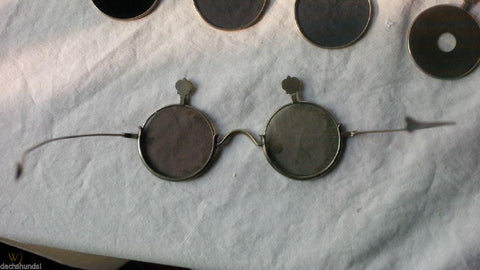
The Crookes glasses sold then were either clear lenses or various darker shades, obviously for extended outdoor usage.

It was in Turin, Italy in 1917, in a small courtyard in Via Caboto, where photographer and optician Giuseppe Ratti began to make technically advanced glasses and sunglasses. These were designed to meet the needs of pilots and sports car drivers, both of whom required comfort, protection and optimum vision.
Thus, Persol Protector glasses were born.
They had round smoked lenses with rubber edges, and were attached to the head with elastic bands. Soon, they were adopted by early military aviators and pilots in the Italian Military Aviation units. Intuition, ingenuity, innovation and quality made Protector aviator glasses the choice of several air forces around the world, including the Army Air Corp in the United States. Protector glasses received notice when Major Gabriele de Annunzio (for whom a model was made to measure), and Captain Natale Palli wore them on their historic flight over Vienna on August 9th, 1918.
Also, Francesco De Pinedo wore them on his transatlantic flight that lasted some 193 hours! During this period they were worn by numerous flying, driving and motorcycling aces including D'Annunzio, De Pinedo, Ferrarin, Chiron, Nazzaro, Fangio, Opessi, Bolognini and Ghersi to name but a few. As the popularity of the Protector aviator glasses grew, Ratti formed Persol Eyewear, which remains to this day as an Italian luxury eyewear company. The name Persol is derived from per il soleâ, which in Italian means "for the sun."
Fast Forward To The 1900's
As aviation takes off after the Wright Brother's first manned powered flight, many different models of aircraft were manufactured as more and more people took off for the wild blue yonder. The number of new aircraft and aircraft improvements exploded during this time period, and the lure of flying captured the imagination of the public. These early pilots quickly discovered how difficult it was to see other aircraft when flying, oil flew back into their eyes from the engines, and their eyes were red and sore after each exhausting flight.
Flight goggles were invented to keep the oil flying off the engine from getting into the pilot's eyes. We all remember those old photographs showing pilots in open cockpit airplanes wearing those famous white scarves; they were used to wipe the oil off the lenses of the goggles. Soon tinted lenses were used to reduce the effects of sun glare on a pilot's vision.

The Flight Goggles worn by Amelia Earhart on her around-the-world flight.
World War I
By 1917 it was clear that war was on the horizon, and the U.S. government had identified Bausch & Lomb as the only American company capable of producing sufficiently high quality glass for lenses in significant quantities. Also, and at the same time, the American Optical Company was chosen to design and build 8 mobile optical units to support U.S. troops and Allied Forces in Europe.
These mobile optical units were filled with frames designed to hold the Bausch & Lomb lenses, and came along with the machinery for the fitting, filling and distribution of prescription glasses and sunglasses. During the war a record 2½ million pairs of glasses and sunglasses were furnished to the U.S. Government for the WWI effort.
In 1924 the Persol Eyewear Company was formed. Protector glasses obtained the first of 14 international patents for glasses. The new glasses were composed of 41 parts, and requiring 43 different assembly procedures. Protector glasses were also adopted by the Swiss Military Department in 1927 after careful analysis. Subsequent development of the Protector model, guided by an intuition and determination to create truly revolutionary sunglasses in terms of quality and ease of wearing, led to the creation of the Persol trademark.
World War II Looms On The Horizon
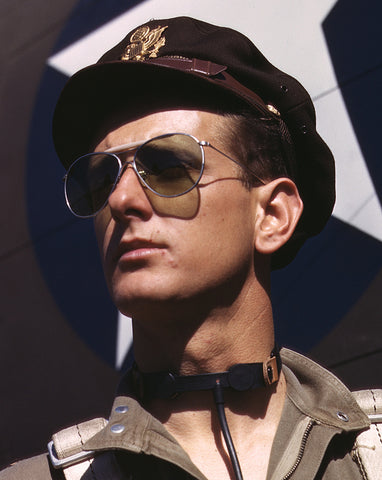
A World War II pilot wearing a pair of AO General Caolbar Sunglasses.
During the early 1930's the American Optical Company was supplying the Army Air Force with aviator goggles, including the U.S.A.C. Goggle Type B-6 and later the B-7 model. The goggles were fitted with severl different colored lenses, including the green calobar, amber, smoke (neutral gray), and clear lenses. At the same time, Bausch & Lomb had created early sunglasses for World War I pilots and now World War II was looming on the horizon.
Thousands of aircraft would be airborne at very high altitudes over enemy territory and it was essential pilot's eyes be protected and that they could spot other nearby aircraft. In 1936 Bausch & Lomb then created the "Ray Ban" aviator sunglasses for pilots using polarizing technology developed by Edwin H. Land. These aviator sunglasses were called "Ray Bans" because they "banned" light rays of certain colors from reaching the pilot's eyes, thus keeping them safe.
Aviator Sunglasses Become A Fashion Statement
Soon a Woolworth's store on the New Jersey boardwalk began selling these Ray Ban aviator sunglasses to the general public. They quickly became very popular as a fashion statement. Film stars found working under the harsh studio lights made their eyes hurt and become red, so they began to wear them as well.
Then they started wearing sunglasses to protect their eyes when not on camera. They also began wearing them outside the studio, and soon fans wanted them too! Since then sunglasses have been a popular choice for many people who love the look for themselves.
Recent History
In the 1960s American Optical introduced the current rectangular shape (sometimes called "Aviators",) commonly worn by military pilots. These became more commonly known as "Aviators" because of their military heritage. As knowledge about the effects of UV radiation on pilot's eyes increased, and as the performance of modern military aircraft increased, the U.S. Department of Defense (DoD) became concerned about the performance and durability of their pilot's sunglasses.
After much research they established the Mil Spec 25948J standard for the ideal military aviator sunglasses for pilots. Also known as the HGU-4/P, the DoD wanted aviator sunglasses that would enhance target acquistion by 6.5-11%, have a VLT of 15% (plus or minus 2%), and a minimum visual acuity of 90%. Since 1982 Randolph Engineering, from Randolph, MA, has been the prime contractor for providing military aviator sunglasses to the DoD.
Today
Today aviator sunglasses are everywhere it seems, but how can you tell the good ones from the bad? Its important for you to know, and you need to understand if good sunglasses are worth the extra money! There are many manufacturers of aviator sunglasses like the ones I have mentioned above - American Optical (now known as AO Eyewear) and Randolph Engineering - but there are several other quality brands as well.
One of them is Eagle Eyes® Optics whose sunglasses story began shortly after the first manned space flight by Alan Shepard in 1961 in the Mercury program Freedom 7 capsule. Shortly after this flight NASA understood that there were a lot of dangers in space, not the least of which was the effect of the sun's rays on astronaut's eyes.
As a result NASA had their Jet Propulsion Laboratory study ultraviolet (invisisble) and blue-light (visible) rays. These rays are now known to conribute to cataracts and age-related macular degeneration. But, more importantly, they needed to figure out how to improve visual acuity while keeping the eyes safe. By the 1970s the scientists had found that birds, like the American eagle, have incredible eyesight and not only can see far into the distance, but deep in the water where fish are; a mainstay of their food chain.
It turned out that the NASA scientists discovered that eagles have unique oil droplets in their eyes which give them this ability to see far and down in the water below. Using the chemical makeup of these unique oil droplets, NASA engineers were able to create new, groundbreaking lens filters, for astronauts to use during space missions. In the 1980s two lens filter technologies were introduced to the public, Avian® and TriLenium®.
This then allowed a company called SunTiger®, now known as Eagle Eyes®, to conduct further development and improvements to the lens technologies. Eagle Eyes engineers conducted a lot of research and development work which earned them a Lifetime Certification Award by the Space Foundation.

The Space Foundation Awards presented to Eagle Eyes® Optics in 2006.
The result was the introduction of a series of eagle eye sunglasses for pilots, outdoor sports enthusiasts, and just plain fashion aficienados. Their flagship products are their Freedom Non-Polarized Eagle Eye sunglasses series of aviator sunglasses for pilots, as well as specialized products like their Eagle Eye night vision and computer screen specific glasses.
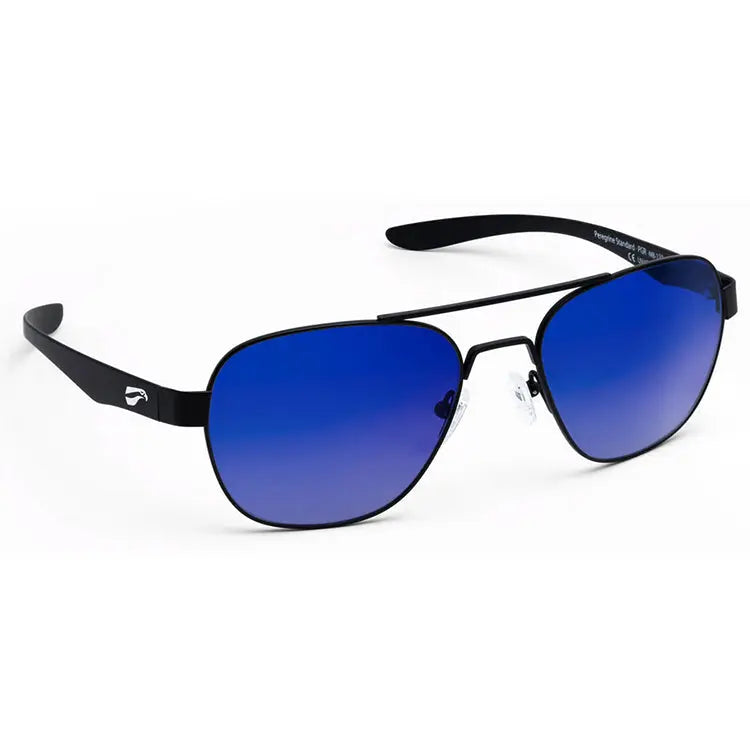
Another new market are Flying Eyes Optics sunglasses, founded and engineered by a groupd of pilots who found that wearing regular sunglasses under the new style of tightly clamping headsets caused pain, particularly on long flights. The first in their excellent line were their Cooper Aviator sunglasses, follwed shortly thereafter by more the more rugged and strong line of Peregrine titanium sunglasses.
They discovered and refined a product called Resilamide™, which is a micro-thin, nearly unbreakable, 1mm thin temples for their line of sunglasses. This solved the problem of the pain and comfort caused by the clamping springs on modern pilot headsets. The clamping also left a gap between the headset cup and the wearer's head, causing interference or even total loss of being able to hear ATC instructions.
New aviator sunglasses brands continue to be introduced including Precision Aviator Sunglasses by Scheyden, and some excellent Method Seven sunglasses for pilots as well.
Conclusion
Hopefully this has cleared up all of the misconceptions and brought some sense to aviator sunglasses history.
I hope you enjoyed this blog post about Sunglasses for Pilots and Aviation Enthusiasts. If you enjoyed this trip, and if you are new to this blog, sign up to receive your own weekly blog post here: Subscribe here!
Until next time, keep your eyes safe and focused on what's ahead of you, Hersch!
p.s. Please share "The Best Aviator Sunglasses History" with your friends. Thanks!



Written by John M. White

Search this site
Recent Posts
-
The Perfect Gift Ideas for Pilots: From Sunglasses to Aircraft Models
October 03, 2026 -
Why Are Aircraft Wood Models Popular Among Collectors?
October 03, 2026 -
Jimmie Angel, Aviator, Explorer, Prospector
September 19, 2026 -
Imagine Finding Yourself In A Freefall from 28,000 Feet!
July 31, 2026


Leave a comment
This site is protected by hCaptcha and the hCaptcha Privacy Policy and Terms of Service apply.