
What Are Optical Notch Filters and What Do They Do?
Have you ever watched one of those reels posted by Mark Smith Photography? He takes videos of birds, and in particular Eagles, as they fly over the water, spot a fish under the surface of the water, an then dive and grab the fish in their talons? I love watching those videos, and I am always amazed at how they can see the fish so far away and under water!

An Eagle in flight just after catching a fish from under the water.
On October 4, 1957, the world woke up and was shocked when the Soviet Union lanched an earth circling satellite called "Sputnik," and the space race was on. America was caught off guard, and quickly decided that the U.S. was going to get moving and win this "space race!"

A photograph of a replica of Sputnik 1, the first satellite in space.
President John F. Kennedy declared the American intention to win the Space Race by proposing a crewed lunar landing before the end of the 1960s. He famously galvanized the nation through a Special Message to Congress on May 25, 1961, and reiterated this historic goal in an iconic address at Rice University on September 12, 1962.
On April 12, 1961,the Soviet Union launched the Vostok 1 spacecraft with Yuri Gagarin aboard. The flight took only 108 minutes while circling eargh. On May 5, 1961, just 23 days later, the United States launched Freedom 7 with Alan Shepard aboard. The race was on, and over the following years the number of manned space flights rose and the U.S. astronauts returned with more and more information about flight in outer space.
By now it was common knowledge that eagles have incredible eyesight, and in fact it is around eight times sharperd than the human eye. As US manned space flights continued and the astronauts returned safely to earth, NASA (National Aeronautics and Space Adminstration learned that the astronauts eyes were having vision problems in space. As a result, NASA assigned a team of NASA scientists to solve the problem, and the scientists began to study to find the true secret of the eagles' vision.
They learned that the secret to the eagles' incredible eyesight was the result of special orange, red, and yellow oil droplets that coated their eyes, and this enabled eagles to spot their prey at great distances, no matter the lighting conditions. They were also able to look down into the water and see the fish, allowing them to swoop down and capture their prey before the fish knew what was happening.
Once the NASA scientists analyzed these unique lens coatings they were able to synthsize them, and NASA knew exactly where they wanted to take this new technology ... into space! Their goal was to protect and enhance astronauts' vision while working on missions in space, to the moon, and beyond. What they had discovered is what we call today "notch filtering," or using ultra-thin layers of alternating layers of dielectric materials. In essence, blocking the light that caused vision problems and allowing in the light they wanted.
Optical notch filters are devices designed to attenuate light within a specific wavelength range to a very low level while transmitting most wavelengths with little intensity loss. Other names for optical notch filters include band-rejection or band-stop filters. They do the opposite of bandpass filters, a different type of filter that provides high out-of-band rejection and high in-band transmission, thus only allowing light transmission within a small wavelength range.
The tilt of the optical notch filter with respect to the incident light is its angle of incidence (AOI). If the incident light is normal to a notch filter, the AOI is 0°. Transmission depends on the AOI for all-dielectric stack filters. As the AOI increases, the central wavelength of the hindering region shifts to shorter wavelengths.
Optical notch filters reject or block a specific wavelength region while transmitting on either side of the blocking region. Traditional notch filters offer up to 85% peak transmission. Optical density (OD) refers to the amount of energy that an optical notch filter rejects or blocks. If the optical density value is high, the filter blocks more energy, resulting in low transmission. If the optical density value is low, the filter rejects less energy, resulting in high transmission.
Optical density is crucial in establishing the strength of a filter. Its measurements can help in measuring the growth of a microorganism’s culture, biomass concentration, and other analytical techniques used in the life sciences. You can find notch filters of different bandwidths in the market, but the most common types are narrowband filters.
Optical notch filters have many applications where there is a need to transmit some wavelengths while reflecting or blocking others. These include sunglasses, optical communication systems, and any process or requirement where the various wavelengths of light need to be eliminated, controlled, or modified. For our purposes, we are interested in the use of notch filtering in sunglasses.
Welcome To Eagle Eyes Advanced Optic Technology
While it is not possible for you to fly like an eagle, that NASA team of scientists and their unwavering dedication, you now can see like one. It is all because of their revolutionary breakthrough and special lens technology that now allows you to see the world like you've never seen it before. While expensive, high style sunglasses may be in vouge, but if they are not using lenses with notch filtering they won't enhance your vision.
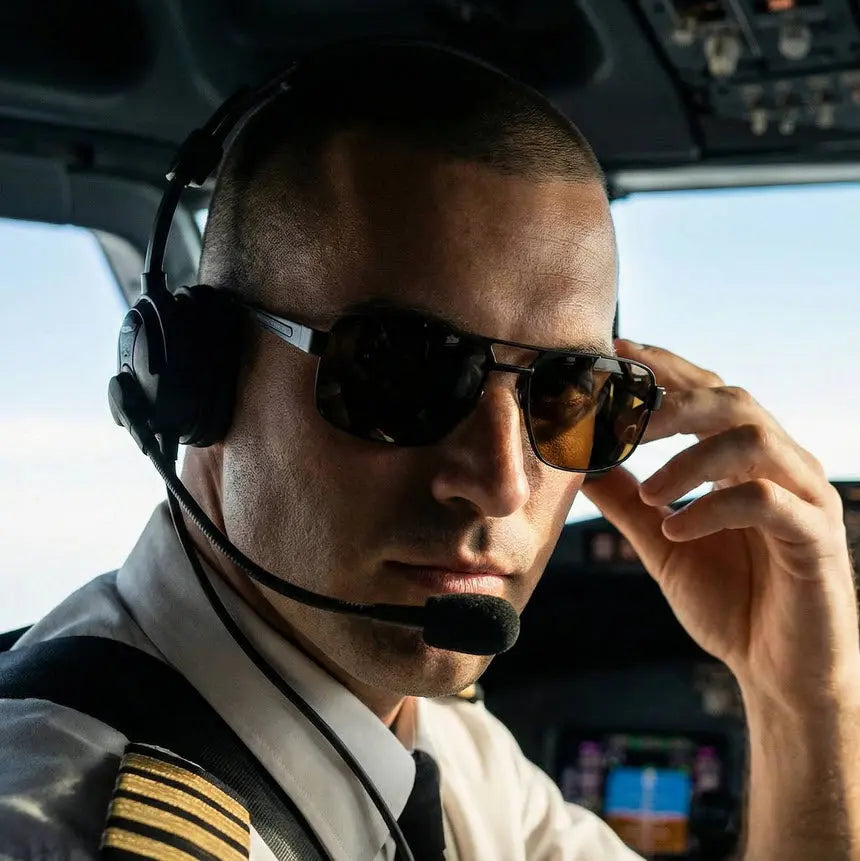
If you want to see the difference, we suggest that you try on a pair of Eagle Eyes sunglasses for pilots. You will notice the difference right away, you will see colors that are brighter, experience better vision clarity, and notice the enhanced definition of objects. In fact, some customers wearing Eagle Eyes TriLenium® polarized lenses even report that their eyes feel cooler when wearing them.
Check out our selection of Eagle Eyes sunglasses today, and enjoy the benefits tomorrow and for a long time thereafter.
I hope you enjoyed this blog post about Sunglasses for Pilots and Aviation Enthusiasts. If you enjoyed this trip, and if you are new to this blog, sign up to receive your own weekly blog post here: Subscribe here!




Written by John M. White

Search this site
Recent Posts
-
The Perfect Gift Ideas for Pilots: From Sunglasses to Aircraft Models
October 03, 2026 -
Why Are Aircraft Wood Models Popular Among Collectors?
October 03, 2026 -
Jimmie Angel, Aviator, Explorer, Prospector
September 19, 2026 -
Imagine Finding Yourself In A Freefall from 28,000 Feet!
July 31, 2026

Leave a comment
This site is protected by hCaptcha and the hCaptcha Privacy Policy and Terms of Service apply.