
The Last USN Ace In A Propellor Fighter
In 1883, Louisiana Lincoln Parish Sherrif Robert E. Russ got word that the Vicksburg, Shreveport, and Pacific Railroad would be transiting the area, and Sheriff Russ thought it would be a good idea to create a town to take advantage of the railroad's route. He donated 640 acres of land for the town, and divided the property into Commercial and Residential lots. Within a year many of the lots had sold, and in 1884 the town was incorporated as Rushton, Louisiana. Yes, you guessed it: they named the town after Sheriff Russ by combining his name with the word town. Viola! Rushton, Louisiana came into existence.
On February 1, 1922, a young lad by the name of Guy Pierre Bordelon was born to his parents in Rushton, Louisiana. Little is known about his parents, nor of his siblings; however, we do know that Guy P. Bordelon graduated from Bolton High Schooll in Alexandria, Louisiana, in 1939. Growing up he became an Eagle Scout, attended pre-law classes at Louisiana Polytechnic Institute, eventually moving on to Louisiana State College where he remained until the middle of 1942.
Guy P. Bordelon joined the U.S. Navy in mid-1942, and in September of 1942 Guy P. Bordelon entered the Navy V-5 Aviation Cadet Program in Athens, Georgia. then on to the pre-flight training in Georgia as an aviation cadet. Trainees underwent initial indoctrination at college campuses for basic academics (geopolitics, mathematics, physics, and navigation). They then attended Naval Pre-Flight Schools (such as in Athens, Georgia) before moving through primary, intermediate, and advanced flight training at massive installations like the Naval Air Station at Hensley Field in Grand Prairie ,Texas.
His flight training began in the Boeing Stearman N2S Kaydet trainer at Hensley Field, Grand Prairie, Texas, near Dallas, TX. He then moved south to Corpus Christi, Texas, for advanced aircraft training. In May of 1943, Bordelon received his gold pilot wings and a commission as an Ensign in the US Navy.

A USN Boeing-Stearman N2S Kaydet trainer aircraft in World War II.
Specifications:
- Crew: 2: pilot + trainee;
- Length: 25 feet;
- Wingspan: 32 feet, 2 inches
- Height: 9 feet, 2 inches;
- Empty weight: 1,936 pounds;
- Max weight: 2,717 pounds
- Powerplant: Lycoming R-680-17 220 hp radial engine;
- Range: 505 miles;
- Cruise speed: 106 mph;
- Max speed: 124 mph;
- Ceiling: 11,200 feet.

A photograph of USN N2S biplane trainers lined up near a runway at NAS Corpus Christi, TX 1942.

Aviation Cadets wearing their flight gear and parachutes heading out to their N2S biplane.
After completion of his training his first assignment was as an instructor pilot, not because he was a good pilot. He barely graduated from the US Navy flight school where he almost washed out. In the spring of 1944, he checked out in the Grumman FM-2 Wildcat. Before the end of World War II he was assigned to a squadron on the USS Corregidor (CVE-58) aircraft carrier. However, he never saw combat, but by now knew his future was to be in Naval Aviation. He quickly applied to become an officer in the regular Navy.

A photograph of the USS Corregidor (CVE-58) in 1944.
He next was assigned to Fighter Squadron 11 to fly the Grumman F6F Hellcat on the USS Valley Forge aircraft carrier. On this tour of duty Borderlon made a trip around the world, and upon returning to the states he served in a number of different fighter squadrons. From there on he servied in a number of command and staff billets until 1950.
The Korean War
By the time the Korean War started in 1950 Lt. Borderlon was a staff officer aboard the cruiser USS Helena (CA-75), a heavy cruiser. In April, 1952, he was assigned command of US Navy Composite Squadron 3 (VC-3), known as the "Blue Nemesis" flying an all-weather radar-equipped Vought F4U Corsair, based at Moffett Field in California. Guy P. Borderlon now began transition training to fly the Vought F4U-5N Corsair night fighter.
VC-3 was then divided into 5-plane detachments, and each detachment was assigned to different US aircraft carriers. Borderlon belonged to Detachment D, which was assigned to the USS Princeton (CVL-23), a light aircraft carrier. Borderlon and his "team dog" performed night interdiction operations over the Korean penninsula. During this time he flew 41 low-level missions against Communist transportation vehicles, and he earned three air medals.
During the Korean War the Communists flew low-level harrasment operations against UN airbases and supply dumps at night. They were called "Bed-Check Charlies," and were flying WWII vintage Polikarpov Po-2 bi-planes.

A Polish built Polikarpov Po-2 bi-plane in flight.
The USAF tried to engage these night intruders using North American F-86 Sabre Jets, but because the F-86s were so fast compared to the slow-moving, prop-driven biplanes, a number of the jets had crashed. So, in the summer of 1953, the U.S. Fifth Air Force requested VC-3 to take on these night intruders.
Borderlon and his pilots transferred ashore to the USMC base on K-6 Airfield at Pyeongtaek, just south of Seoul, from where they conducted nightly patrols.

A photograph of K-6 Aifield, Pyeongtaek, 1952-1953, just south of Seoul, South Korea.

Lt. Guy Bordelon looking at the name plate Annie-Mo on his Vought F4U-5N Corsair fighter.
The significance of the image above is because Borderlon had married Ms. Anne Craig Taylor of Ruston, Louisiana in March of 1944. During his time at the K-6 Airfield he became an ace, achieving all of his victories in the same Vought F4U-5N Corsair, Bureau number 124453 NP-21. It was named "Annie-Mo" in honor of his wife.

A Vought F4U-5N Corsair in flight.
F4U-5N Corsair Specifications:
- Crew: Pilot;
- Length: 34 feet;
- Wingspan: 41 feet;
- Height: 14 feet, 8 inches;
- Max Speed: 470 mph (408 knots);
- Ceiling: 45,000 feet;
- Range: 1,036 miles (882 nm);
- Powerplant: Pratt & Whitney R-2800-32W developing 2,459 hp;
- Armamant: 4 x 20mm M-3 cannons with 924 rounds.
On June 29, 1953, shortly before midnight, an inturder was picked up on radar at the K-6 Aifield. Lt. Borderlon was dispatched in his F4U-5N, and after takeoff a ground controller vectored him onto the tail of the intruder. The intruder was flying a Yakovlev YAK-18, and the rear seater fired at Bodrerlon just as he opened fire with his 20mm cannons and destroyed the Yak-18.

Flown by North Korean defectors, this Yak-18 landed in South Korea in 1955.
As soon as Borderlon reported his kill to the base, the ground controller vectored him onto a second Yak-18. Same as before, the rear crew member opened fire on Borderlon, but it was of no help as Borderlon flamed the plane, watched in burn as it broke up and fell to the ground.
The next night, on June 30, 1953, Borderlon was flying CAP (Combat Air Patrol) north of Inchon when he was vectored by ground control radar onto several Lavochin La-11 fighters flying in a loose trail formation. Lt. Borderlon pulled up behind the rear La-11 and fired two short bursts at the aircraft. The La-11 began to burn, and then id dove straight down towards the ground.
The lead La-11 started to follow the burning wingman down, so Borderlon closed and immediately fired at it. The La-11 tried evasion by turning left, then right, then started to climb as Borderlon fired another burst at him. The La-11 exploded was burning, and then just fell apart. Borderlon followed the burning mass down to about 500 feet and watched it crash nearby the first La-11.

A photograph of a Lavochin La-11 fighter.
By now Borderlon had earned the nickname of "Lucky Pierre" for some of his daring aerial stunts. An example of his daring occured one evening when he encountered two Tupolev Tu-2 bombers, but when he went to fire on them nothing happend as the guns had malfunctioned. So, true to form, he decided to play "chicken" with the bombers! He went full throttle and pulled ahead of the bombers, then reversed course and headed directly at the bombers with landing gear lowered and landing lights on! At the last second the bomber pilots flinched, one pulling straight up while the other dove straight down.
On July 16, 1953, Borderlon was on another vector towards a new target. It took him several minutes, and the use of his radar, to locate the lone La-11. As soon as Borderlon was about to fire, the La-11 began violent evasive manuevers. Not to be deterred, and despite AA ground fire, Borderlon was able to fire a long burst from his cannons. The La-11 exploded.
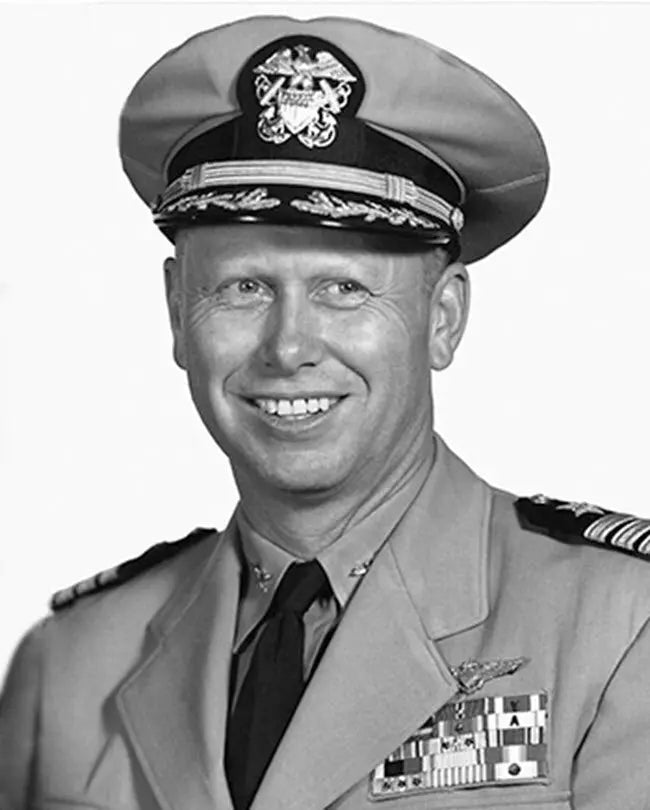
The news of Borderlon's fifth kill and becoming an ace was soon forgotten as on July 27, 1953, the armistice was signed at Panmunjom, ending the fighting in Korea. Borderlon was awarded the Navy Cross for his service in Korea, and among his many assignements after Korea he served as Commander, Task Force 140, supporting Apollo astronauts recovery missions.
The Navy Cross Citation (Action Date: July 17, 1953):
"The President of the United States of America takes pleasure in presenting the Navy Cross to Lieutenant Guy Pierre Bordelon (NSN: 0-278231), United States Navy, for extraordinary heroism in connection with military operations against an armed enemy of the United Nations while serving as Pilot of a night fighter plane in Fighting Squadron ONE HUNDRED FIFTY-TWO (VF-152), embarked in U.S.S. PRINCETON (CVS-37), in action against enemy aggressor forces in the vicinity of Seoul, Korea, on 17 July 1953. While flying a night mission, Lieutenant Bordelon intercepted and destroyed a Communist night intruder aircraft bringing to a total of five such aircraft he has destroyed recently, thereby becoming the first Navy pilot to achieve such a record during the Korean War. For many months the enemy has conducted a series of night air raids which constituted a serious threat in the thickly populated area of Seoul, and Lieutenant Bordelon's actions have assisted materially in the removal of this threat. He exhibited superior ability and airmanship by maneuvering his plane into an attack position which enabled him to destroy the enemy aircraft. His conspicuous gallantry, fearless aggressiveness and unparalleled performance in pressing home vigorous and superbly executed attacks contributed directly to the successful accomplishment of his assigned mission. By his outstanding professional skill and great personal courage, Lieutenant Bordelon's accomplishments represent an important increase in the night security of friendly forces. His conduct throughout reflects great credit upon himself and was in keeping with the highest traditions of the United States Naval Service.
After 27 years in the Navy, Guy Pierre Borderlon retired in 1969. Borderlon had flown more than 15,000 hours, earned the Navy Cross and two Silver Stars. He and Anne later returnd to Louisiana. On December 19, 2002, he passed away at his home in Alexandria, Louisiana. Borderlon is remembered as the last and only USN pilot to become an Ace flying a piston-powered propellor fighter.
I hope you enjoyed this trip through some of the history of aviation. If you enjoyed story, please share it with all of your friends. And, if you are new to this blog, sign up to receive your own weekly blog post here: Subscribe here!
Until next time, keep your eyes safe and focused on what's ahead of you, Hersch!




Written by John M. White


Search this site
Recent Posts
-
The Perfect Gift Ideas for Pilots: From Sunglasses to Aircraft Models
October 03, 2026 -
Why Are Aircraft Wood Models Popular Among Collectors?
October 03, 2026 -
Jimmie Angel, Aviator, Explorer, Prospector
September 19, 2026 -
Imagine Finding Yourself In A Freefall from 28,000 Feet!
July 31, 2026

Leave a comment
This site is protected by hCaptcha and the hCaptcha Privacy Policy and Terms of Service apply.