
The Defiant One: Col. Robin Olds, USAF
Robert Oldys was born on June 15, 1896 in Woodside, Maryland to Henry Oldys and May Clendenin Meigs Oldys. His father was an ortnithologist and his grandfather was a former physician and infantry veteran of the Mexican-American War. His grandfather was also an Episcopal minister and on July 7, 1865, stood on the gallows at the hanging of the conspirators in the assassination of Abraham Lincoln.
Robert Oldys senior was a personable, charismatic, and highly outspoken, and was strongly infulenced by his association with General William "Billy" Mitchell. While he was thought of at being skilled in the art of diplomacy, particularly as an early advocate for air power, his outspokeness resulted in several public rebukes.
Robert Olds(y) became an instructor pilot at the Air Corps Tactical School at Langley Field in Virginia. The motto of the school was "Proficimus More Irretenti" in Latin, which in english means “We make progress unhindered by custom.” Early aviators could not be hindered by custom—they had to innovate, and Roberty Olds(y) certainly continued that way throughout his career in the US Army Air Corps.

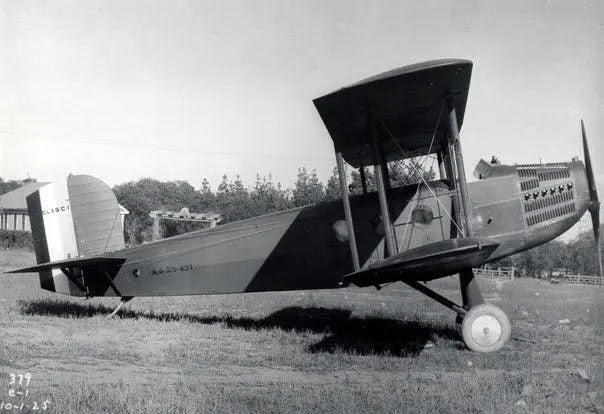
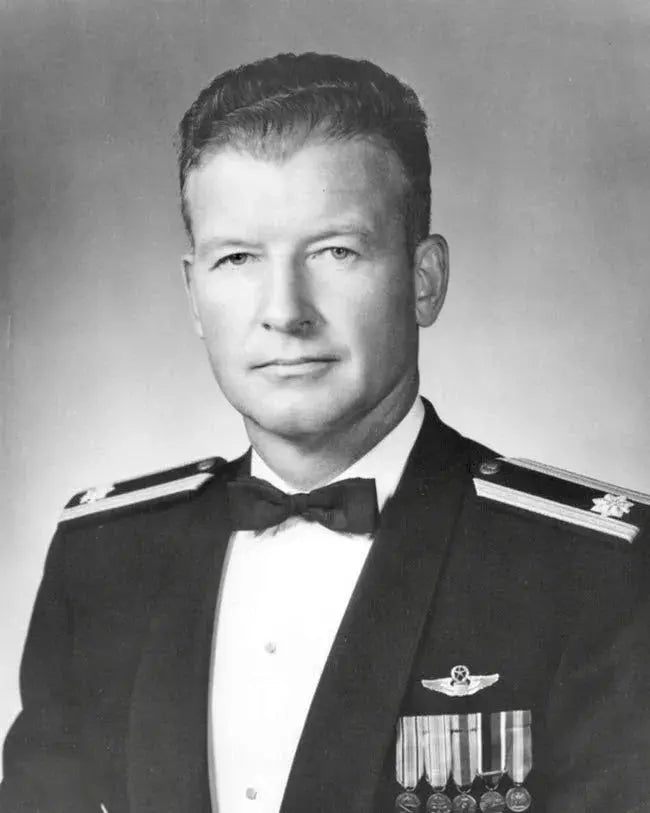
Lt. Col. Robert Oldys, US Army Air Service (Aviation - Pilot).
Robert Oldy(s) was married four times, the first of which was to Eloise Karen Wichman Knott. It was on a a bright, sunny day in Honolulu, Hawaii, at Luke Field Hospital, where the first son of Captain Roberty Olds(y) of the US Army Air Service, was born to he and his wife Eloise. They named their new son Robert Oldy(s), Jr., but In 1931 the family decided to change their last name from Oldy(s) to Olds. Their new child was called "Robin," a dimunation version of Robert.
His mother passed away when Robert "Robin" Jr. was just four years old. Growing up primarily at Langley Field in Virginia, young Robin made daily contact with the small group of young officers who would eventually lead the U.S. Army Air Forces in World War II. One of his neigbors was Major Carl Spatz, destined to become the first Chief of Staff of the United States Air Force.
So, imagine being brought up in a family with a father who was an accomplished aviator and flight leader, determined to advance aviation! No doubt, Robert Olds Jr. was destined to grow up with a love for aviation, especially in the United States Army Air Corps. Soon Robert (Robin) Olds Jr. would become another pilot in the US Army Air Corps. Young Robin Olds took his first flight with his father in an open cockpit biplane operated by his father.
In 1937 his father became the commander of the 2nd Bombardment Group with Boeing B-17 Flying Fortress aircraft based at Langley Field in Virginia. He quickly rose in rank to Lt. Colonel on March 7, 1937. In the meantime his son, Robin Olds, attended Hampton High School where Robin Olds played varsity football and was elected three times to be class president. By now Robin Olds was an agressive, evenmean, football player, and received invitations from colleges like VMI and Dartmouth on scholarship.
In 1939, Robin Olds decided not to apply to college, but rather to enroll at Millard Preparatory School for West Point in Washington, D.C. But very soon thereafter Nazi Germany invaded Poland, and young Robin Olds wanted to joing the Royal Canadian Air Force; however, his father would not sign his enlistment papers and so Robin decided to take a different path.
He continued at Millard Prep and upon graduation applied to West Point. He was given a nomination to West Point by Congressman J. Buell Snyder of Pennsylvania. Robin Olds moved to Unitontown, PA, where he lived and worked odd jobs until he passed the West Point entrance exam and was accepted into the class of 1944 on June 1, 1940. He then entered West Point where he excelled at footbal. In fact, In 1942 he was seleced as an All-American tackle.
On December 7, 1941 the Japanese attacked Pearl Harbor, and Robin Olds left West Point to attend flight training at the Spartan School of Aeronautics in Tulsa, Oklahoma, for flight training. By Christmas time 1942, Robin Olds completed his flight training and returned to West Point with the hope of graduating early enough in time to see action in the war. At that time Congress decided to shorten the curriculum to three years instead of four for the duration of the war.
On his way back to West Point Olds went through advanced training at Stewart Field in Newburgh, New York. Upon completion of his pilot training Olds graduated from West Point on June 1, 1943 where he received his wings from General Henry "Hap" Arnold, and his commission as a 2nd Lt.
Much like his father, Robin Olds was a bit headstrong, and while he was dedicated to "Duty, Honor, Country," Olds had a problem following the West Point Honor Code. While on leave, Olds had consumed some alcohol, and upon his return to West Point he was confronted about his alcohol consumption resulting in him being reduced from a cadet captain to a cadet private, only the second cadet in history to earn that honor.
Next, 2nd Lt Olds was assigned to report to the West Coast for training in the P-38 Lightning, followed by his posting to the 479th Fighter Group's 434 Fighter Squadron, which had been ordered to Great Britain.

A photograph of young 2nd Lieutenant Robin Olds with “SCAT II,” a Lockheed P-38J-15-LO Lightning, 43-28707.
Specifications:
- Crew: 1 pilot;
- Length: 37 feet, 10 inches;
- Height: 12 feet;
- Wingspan: 52 feet;
- Empty weight: 12,800 pounds;
- Gross weight: 17,500 pounds;
- Powerplant: 2 each 1,475 Allison V-1710 liquid cooled engines;
- Maximum speed: 414 mph;
- Ceiling: 40,000 feet;
- Maximum range: 1,100 miles;
- Armament: 4 x 0.50 caliber machine guns, 1 20mm caliber cannon, 4,000 pounds of bombs.
Olds decided to name his P-38J aircraft the "Scat II" when he arrived in Great Britain in May of 1944. Olds was meticulous and wanted to understand everything about this aircraft he was about to fly in combat. As a result, he worked closely with his crew chief to learn everything he could about aircraft maintenance.
On July 24th 1944, Olds was promoted to Captain and was sent on a low-level mission over Montmirail, France. Soon he spotted a pair of German Focke Wulf FW-190s, then quickly pulled up behind the trailing FW-109, and at 400 yards opened fire with a six-second burst, hitting the left wing of the FW-109, followed by pulling his gunfire onto the fuselage.

A German Focke Wulf FW-109 of the Luftwaffe in flight.
The second FW-109 pulled a 360 degree turn, but Olds was able to keep up with him and was able to put a five second burst into the second FW-109, which then pitched up and the German pilot bailing out of the aircraft. Olds did not see the first Focke Wulf hit the ground, but he did see the pilot of the second one bail out.
A month later, on August 25th, 1944, Capt. Olds was leading a four-ship flight of P-38s who were escorting bombers over to Wismar, Germany, near Berlin, when Olds flight encountered 55 German BF-109s. Two pilots in his formation didn't like the odds, so they broke away from the fight and headed for home.
Not Olds and his wingman! Instead, Olds and his wingman engaged the enemy, and despite being outnumbered 27 to 2, Olds managed to shoot down 3 enemy BF-109s. Even though Olds' P-38 was heavily damaged, he was able to return to base that day and become the squadron's first ace, making him the last P-38 ace of the Eighth Air Force. Olds also claimed three more unofficial kills that were not able to be verfified by witnesses.

A German Messerschmitt BF-109 waiting on alert at an airfeild somewhere in Germany.
In the middle of September the 434th fighter squadron began transitioning to the North American P-51 "Mustang". Because the P-51 "Mustang" was a single engine fighter, it handled a lot differently than the P-38 Lightining, requiring some readjustment to fly it.

Capt Robin Olds on the wing of his P-51 Mustang "Scat VI". Note the Swastikas just below the canopy of his P-51 denoting the number of enemy kills.
North American P-51 "Mustang" Specifications:
- Crew: 1;
- Length: 32 feet, 2 inches;
- Height: 13 feet, 8 inches;
- Wingspan: 37 feet, 0 inches;
- Engine: Merlin 12 cylinder liquid cooled 1490 hp engine;
- Max speed: 505 mph;
- Gross weight: 12,300 pounds;
- Ceiling: 41,900 feet;
- Range: 2,080 miles with two 110 gallon drop tanks;
- Armament: 6 x .50 caliber Browning machine guns, 2 with 270 rounds per gund and 4 with 400 rounds per gun.
Capt. Olds scored his first victory in the P-51 on October 6, but did not add to his tally again until February of 1945. He completed his tour of duty in November, and was given two months' leave back in the states. He returned in January of 1945, promoted to Major on February 9, 1945, and earned his seventh aerial victory the same day using his P51D's new K-14 gunsight to hit a BF-109 at 450 yards over Magdeburg with his first burst.
This surprised Maj. Olds, but he closed in on the BF-109 firing twice more sending the Messerschmitt down in flames. Five days later he claimed three more kills, but was only credited for two with the other listed as "probable."
During the closing days of World War II Olds, in April of 1945, participated in raids on German airfields to destroy enemy aircraft on the ground. While these seemed to be low-risk missions, Olds recalled that they were actually quite dangerous. For examle, later on a raid against the Tarnewitz airfield Olds' badly damaged Mustang was the only one of the five to make it back after the raid.
Maj. Olds really loved his airplanes, and as he nursed his crippled Mustang back to base, he found out it stalled at 175 mph and rolled violently. But he said that "Scat VI had taken me through a lot and I was damned if I was going to give up on her."
By the end of the war Olds' record was 12 confirmed and one probable aerial victories, along with 11.5 enemy aircraft destroyed on the ground.
| World War II Record of 12 Confirmed Kills: |
| August 14, 1944 - 2 FW-109s |
| August 25, 1944 - 3 BF-190s |
| October 6, 1944 - 1 |
| February 9, 1945 - 1 BF-109 |
| February 14, 1945 - 2 FW-190s, 1 BF-109 (only FW-190s credited) |
| March 19, 1945 - 1 FW-190, 1 BF-109 |
| April 7, 1945 - 1 BF-109 |
Career After World War II:
Upon returning to the states he reverted back to his permanent rank of Captain. He then served with 412th Fighter Group at March Field in California, and trained on the Lockheed P-80 "Shooting Star" jet fighters. During 1946 Olds and Lt. Col. John C. "Pappy" Herbst flew as a jet demonstration team.
Some men have all the luck, and Capt. Olds was one of them. While he was based at March Field he met Hollywood actress Ella Raines on a blind date in Palm Springs, CA. They were married on February 6, 1947 and had two daughters, Christian and Susan, and a son, Robert Ernest, who was stillborn in 1958. During their 29 year marriage she refused to live in government housing on base with her husband. As a result of extended separations, and a clash in lifestyles, they divorced in 1976.

Movie actress and wife of Col. Robin Olds, USAF.
Much like his father, Robin Olds was frustrated with the military, and considered leaving the Air Force. However, over the next years Olds served in various staff positions, but he itched to get back into the cockpit once again. Finally, in 1955, he became commander of the 86th Fighter-Interceptor Group which were flying North American F-86 Sabre jets.
In 1963 Olds graduate from the National War College, and from 1963 through 1965 commanded the 81st Tactical Fighter Wing flying McDonnell F-101 Voodo fighter-bombers back in Great Britain at RAF Bentwaters. Here, while by his own admission nearly got him court-martialed, for forming an impromptu aerobatic team with his pilots. He was, nonetheless, relieved of his command and sent back to the U.S.
The Vietnam War
By this time a Colonel, Olds was given command of the 8th Tactical Fighter Wing "Wolf Pack" based at the Royal Thai Air Base in Ubon, Thailand, a wing which was engaged in combat in Vietnam. As soon as he arrived he joined the flight schedule with junior but combat experienced pilots. Unlike the earlier commander who flew just 12 combat sorties, Col. Olds took on a regular flight schedule, just like the rest of the units' pilots.
Typical of Olds and his father, when he first arrived he went through the normal indoctrination, paying close attention, and rarely spoke. By the time Olds reached the front office he felt he knew all he needed to know, and he quickly began to clean house. He got rid of the deadwood, those "ticket punchers and careerists" who flew missions that counted towards tour completion, and who never went to North Vietnam.
Olds told the F-4C crews "I’m going to start here by flying Green Sixteen (tail-end Charlie) and you guys are going to teach me how. But teach me fast, and teach me good, because I’m a quick learner.” Sitting in the audience was Capt. Ralph Wetterhahn, a future MiG killer. Impressed by the new CO's press-on attitude, the Wolfpack began showing results.

Col. Olds in front of a Phantom II jet with some of his Wolfgang pilots.
In late 1966, the North Vietnamese Mig fighters became more active, and that resulted in their kill ratio against U.S. pilots began to increase rapidly. From Ubon, the 8th TFW flew McDonnell Douglas F-4 Phantom IIs, conducting critical combat missions over North Vietnam, developing night tactics, and achieving significant success against enemy MiGs. Col. Olds proposed a counter operation designated as "Bolo," which used F-4 Phantom IIs to mimick F-105 Thunderchiefs strikes to lure enemy aircraft into an ambush.

Col. Robin Olds’ F-4C Phantom II FP/63-7680, as it appeared during Operation "Bolo", January 2, 1967. Notice the missing chin gun pod, which was not yet retrofitted at the time of Operation "Bolo."
McDonnell Douglas F-4C Phantom II Specifications:
- Crew: 2,
- Length: 63 feet, o inches;
- Height: 16 feet, 5 1/2 inches;
- Wingspan: 38 feet, 7 1/2 inches;
- Max Take-Off weight: 61,795 pounds;
- Maximim speed: 1,430 mph at 36,000 feet;
- Service Ceiling: 58,750 feet;
- Powerplant: Two J79-GE-17A Turbojets for 17,900 pounds of thrust;
- Armament: 1 X 20mm M61A1 six-barrel canon with 640 rounds; 16,000 pounds of disposable stores, including nuclear weapons, ASMs, AAMs, free-fall or guided bombs, cluster bombs, napalm tanks, dro tanks and ECM pods, carried on nine external hardpoints.

Col. Robin Olds in front of an F-4C Phantom in Vietnam.
Operation "Bolo" began on January 2nd, 1967, and the immediate result was the decimation of the North Vietnamese Air Force's Fighter Regiment, losing seven confirmed and two probable kills of MiG-21s that day. No U.S. aircraft were shot down that day, a day in which Col. Robin Olds personally led the strike force and made his first aerial victory in Vietnam. After the loss of two more MiG-21s on January 6, 1967, the North Vietnamese Air Force retired from engaging U.S. aircraft for two months.
Col. Olds was not done yet. In May of 1967, Olds scored three more kills, making him the highest scoring pilot since the start of the war. No doubt he could have killed more, but he knew if he did he would become a "media hero" and be sent home.
Olds opined that "There are pilots and there are pilots; the good ones are natural. You can't teach it." In the aerial fights over Vietnam, Olds used vertical maneuvering, a tactic not commonly used by U.S. pilots at the time. Those who were fortunate enough to observe him in action marveled at his ability to anticipate and to control the rapidly changing conditions of aerial warfare.
Upon his return to the U.S., Olds was acclaimed as America's "top gun" of the war to date, a record he held fo the next five years. His proudest attack, however, was when he and two wingmen made an ultra low level attack against North Vietnam's most heavily defended target: The Thai Nguyen steel mill. But, what he valued the most, was the courage and skill of his air crews.
In September of 1967, Olds was made the Commandant of Cadets at the US Air Force Academy. He was promoted to Brigadier General on June 1, 1968, and he worked hard to restore pride in the school after a large cheating scandal had sullied it's reputation. In 1971 he moved on to desk jobs; although, when reviewing operations of the USAF units in SE Asia, he toured bases and flew several unautherized combat missions.
Some things never change!
On June 1, 1973, Brigadier General Robin Olds, after being denied the opportunity to return to operational command, he decided to leave the Air Force. He retired with 17 career victories, and when the triple ace died, he was America's third-ranking living ace. He flew a total of 259 combat missions, with 107 in World War II and 152 in Southeast Asia.
His Scat XXVII (Phantom F-4C-24-MC 64-0829, the plane he flew for his four MiG kills, was retired from active duty and is on display at the National Museum of the United States Air Force at Wright-Patterson Air Force Base in Ohio, including four red MiG stars representing hi MiG kills in Vietnam.
I hope you enjoyed this trip through some of the history of sunglasses. If you enjoyed this trip, and if you are new to this blog, sign up to receive your own weekly blog post here: Subscribe here!
Until next time, keep your eyes safe and focused on what's ahead of you, Hersch!




Written by John M. White

Search this site
Recent Posts
-
The Perfect Gift Ideas for Pilots: From Sunglasses to Aircraft Models
October 03, 2026 -
Why Are Aircraft Wood Models Popular Among Collectors?
October 03, 2026 -
Jimmie Angel, Aviator, Explorer, Prospector
September 19, 2026 -
Imagine Finding Yourself In A Freefall from 28,000 Feet!
July 31, 2026
Leave a comment
This site is protected by hCaptcha and the hCaptcha Privacy Policy and Terms of Service apply.