
A Legendary Dogfight
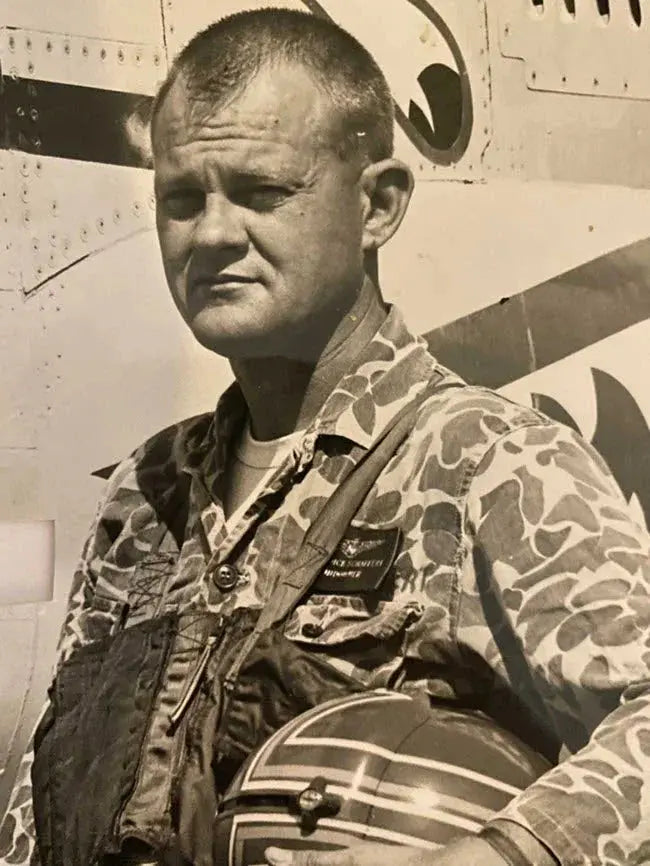
Last week my post was about Lt. Cdr. Richard W. Schaffert, USN, and his exploits as a pilot with the Fighter Squadron VF-111 'Sundowners' flying the Vought F-8C Crusader off of the carrier USS Oriskany. Today, I continue with more history for this extraordinary pilot's exploits in the Vietnam War.
VF-111 was originally established as Fighter Squadron 11 on October 10, 1942, then redisgnated as VF-11A on November 15, 1946, followed on July 15, 1948 as Vf-111, but disestablished on January 19, 1959. On Janueary 20, 1959, another squadron then assumed the designation VF-111 until it was disbanded in 1995.
However, during the Vietnam War, Fighter Squadron VF-111, which called themselves the "Sundowners," logged six deployments, scoring MiG kills in Vought F-8C Crusaders and McDonnell Douglas F-4 Phantom IIs in the skies over Vietnam.
On December 14, 1967, an Operation "Iron Hand" was ordered to protect a major air wing strike on the Taun Tinh Ferry Crossing near Haiphong in North Vietnam. An "Iron Hand" operation is where the U.S. Air Force and U.S. Navy conducted joint operations to suppress surface-to-air (SAM) sites and anti-aircraft artillery batteries (AAA) before the arrival of a major strike package of other aircraft.
Lt. Cdr. Richard William Schaffert, flying his Vought F-8C Crusader, was dispatched from the USS Oriskany as fighter cover for the Douglas A-4E Skyhawk aircraft armed with AGM-45 Shrike anti-radiation missiles. These A-4E missions involved flying directly towards radar-emitting SAM sites, force them to activate their radar, and then target them with the A-4E Skyhawk aircraft AGM-45 missiles.
On this day, Lt (jg) Charles Nelson was the pilot of the A-4E Skyhawk for Operation Iron Hand, while Lt. Cdr. Schaffert would provide high air cover for him from 18,000 feet above. As the section arrived at its target area, south of the strike group, Lt Cdr Schaffert and his teammate had begun attacking electronic missile signals when he observed two MiG 17s at twelve o’clock, five miles, converging on them. He immediately took the lead of the section as the two flights of aircraft met head-on.

A photograph of a captured North Vietnamese MiG 17 fighter jet.
It was nearly impossible for an F-8C Crusader to turn with a MiG-17, so Lt Cdr Schaffert executed a hard, nose-high turn to engage the enemy and, as he completed this maneuver, he glanced over his shoulder, checking for the A4E position, only to find two additional MiG 17s diving out of the sun on his tail.
So, Lt Cdr Schaffert did what Crusader pilots did best, he began a series of Yo-Yo manouvers. After three more ‘yo-yos’, Schaffert had worked into position for a missile shot, but the AIM-9B passed between two MiGs without exploding. One of his four Sidewinders had been inoperative before launch, so he was now left with just two missiles.
Click on image below to see a video showing what a high yo-yo manouver is like:

Lt Cdr Schaffert made calls for assistance from other fighters in the strike group, and continued with the engagement at hand. He aggressively pressed his attack on the first section, rejecting for the moment those closing from his six o’clock. By this time, the second element of MiGs had closed on him and both fired their 37mm cannons as he followed the first group.
The MiG pilots were observed to be extremely combat capable and after the first two turns, locked Lt Cdr Schaffert in a rolling vertical scissors maneuver. At this point the pair of enemy fighters in trail fired 4 Atoll missiles, two from each aircraft. The air-to-air missiles, impaired by their target’s high G maneuvers, faded far behind and offered no further threat.
One advantage Schaffert had was the MiGs operated as two sections of two each MiGs at a time, making his battle a one against two fight. The first time Schaffert got a tracking tone from one of his Sidewinder air-to-air missiles and prepared to shoot he was surprised by tracers flying past his canopy!
It turns out the second pair of MiGs had reversed and countered Schaffert's attack on the first pair of MiGs. Three more yo-yos later he made a missile shot with an AIM-9B Sidewinder, but it passed between the pair of MiGs without exploding. This left him with just two more missiles.
In the next turn, Lt Cdr Schaffer fired his first Sidewinder at the wingman of the first section of MiG-17s. His weapon failed to guide as he continued to relay his position and altitude to the additional fighters now closing on the area, as he carried on this fearless battle against overwhelming odds.
The second section of MiGs now bracketed Lt Cdr Schaffer closely on both sides firing their cannons as they alternately passed his six o’clock position. His determined aggressiveness drove him to continue pressing his own attack, disregarding the ominous threat at his back, and he fired two additional Sidewinders at the wingman of the first section.
By now Schaffert is working very hard, timing his breaks and pitch-ups, sustaining high-G overhead reversals to defeat the MiGs' superior turning ability. His next missile tracked the MiG but failed to explode while two MiGs fired Atoll heat-seeking missles at him. By now he is frustrated that all of his three shots malfunctioned.
The first Sidewinder again failed to guide; the second guided but missed its mark by a narrow margin. Still receiving heavy cannon fire, he pressed closer to the first element for a final offensive effort with his 20mm guns. At this point, and low on fuel and ordnance, and faced with increasing fire from astern, he concentrated on losing the second section of MiGs on his tail.
The first element of MiGs, freed from Lt Cdr Schaffer’s attack, seized the opportunity to take the offensive and unleashed their four Atoll missiles. However, his superlative airmanship deterred optimum firing position for the MiGs, and with their ordnance nearly expended, they broke off the engagement taking vectors toward Hanoi.
Additional F8 fighters were now on the scene and engaged the departing MiGs. One was overtaken and subsequently destroyed. Had Lt Cdr Schaffer demonstrated less aggressiveness during this prolonged aerial engagement, he would have presented any one of the MiGs the optimum shot and very likely would have become their victim.
Determined to teach these MiG pilots a lesson, Schaffert pulled up into another high yo-yo manouver, engaging them in a vertical rolling scissors on the lead enemy MiGs. At the bottom of the manouver Schaffert broke off the 10-minute engagement and headed for the USS Orinsky, landing with just 200 pounds of JP-5 left!
Only by his unexcelled fighting ability, undaunted determination to gain a kill, and masterful composure was he capable of holding the encounter to a draw and escape without damage under the most overwhelming odds.
A Distinguished Flying Cross
The recommendation for a DFC for LCDR SCHAFFERT was approved by CINCPACFLT on 8 January 1968 and the DFC CITATION reads…
“For heroism and extraordinary achievement in aerial flight as a jet fighter pilot attached to and serving with Fighter Squadron ONE HUNDRED ELEVEN, embarked in USS ORISKANY (CVA-34) while participating in an aerial engagement near Thai Binh, North Vietnam on 14 December 1967. Lieutenant Commander SCHAFFERT distinguished himself by his conspicuous valor and undaunted determination while solely battling four MiG 17 enemy jet aircraft over hostile territory. Taken under attack while escorting an A4E surface-to-air missile suppression aircraft, he aggressively assumed lead of the section and, against the overwhelming odds fearlessly engaged the enemy fighters. During the several minutes of battle which followed, Lieutenant Commandeer SCHAFFERT displayed unequaled skill in offensive and defensive air-to-air combat, maneuvering as the four highly maneuverable enemy aircraft concentrated their attack on the lone friendly fighter. The coordinated attack of the extremely capable MiG pilots failed to equal the brilliant combat maneuvering of Lieutenant Commander> SCHAFFERT and the eight guided missiles and heavy cannon fire unleashed by the enemy were unable to find their mark. In his own aggressive attack during the engagement, Lieutenant Commander SCHAFFERT deterred the enemy from continuing an assault on the main strike force or on his teammate and detained the enemy fighters until other friendly forces arrived in the area. With the initial engagement closing in a draw, the four enemy aircraft disengaged toward the protective defenses on Hanoi. Directed by Lieutnenant Commander SCHAFFERT and his A4E teammate, the friendly fighters engaged and, in the ensuing battle, destroyed one enemy aircraft. Lieutenant Commander SCHAFFERT’s courage, superlative airmanship and dogged determination in the face of overwhelming odds were in keeping with the highest traditions of the United States Naval Service."
A Tradition of a Comrade in Arms
In last weeks blog post I told you about Lt. Cdr. Schaffert's relationship with his shipboard roommate on the USS Oriskany, Lt. Cdr. Norm Levy. The story involved the tragic death of Lt. Cdr. Norm Levy when a flare locker exploded causing a large fire on the USS Oriskany.
Each year Schaffert would write a note to Norm, at first in the form of a paper airplane, set it on fire and sail it off the deck of the USS Oriskany. What follows is a copy of the letter Schaffert wrote to Lt. Cdr. Norman Sidney Levy, US Navy Deceased (1934-1966):
"Good morning, Norm. It’s Memorial Day 2014, 07:29 Tonkin Gulf time. Haven’t talked with you for a while. That magnificent lady on which we went through hell together, USS ORISKANY, has slipped away into the deep and now rests forever in silent waters off the Florida coast. Recall we shared a 6′ by 9′ stateroom aboard her during McNamara and Johnson’s ill-fated Rolling Thunder, while our Air Wing 16 suffered the highest loss rate of any naval aviation unit in the Vietnam conflict. Three combat deployments, between May ’65 and January ’68, resulted in 86 aircraft lost from the 64 assigned to us; while 59 of our aviators were killed and 13 captured or missing from Oriskany’s assignment of 74 combat pilots. Our statistical probability of surviving Rolling Thunder, where the tactics and targets were designated by combat-illiterate politicians, was less than 30%. The probability of a combat pilot being an atheist approached zero!
Seems like a good day to make contact again. I’ve written every year since I threw that “nickel on the grass” for you. For several years, it was only a handwritten note … which I ceremoniously burned to simulate your being “smoked.” With the advent of the internet, I shared annual emails to you with some of our colleagues. Unfortunately, the net’s now a cesspool of idiocy! Much of it generated by those 16 million draft dodgers who avoided Vietnam to occupy and unionize America’s academia; where they clearly succeeded in “dumbing down” an entire generation which now controls the heartless soul of a corrupt “Hollywoodized” media. This will be my last letter. I’m praying Gabriel will soon fly my wing once more, and I look forward to delivering it to you personally.
This is the 47th year since I last saw you, sitting on the edge of your bunk in our stateroom. You remember … it was the 26th of October 1966 and we were on the midnight-to-noon schedule. There was a wall of thunderstorms over North Vietnam, with tops to 50,000 feet, but McNamara’s civilian planners kept sending us on “critical” missions all night. At 04:00 they finally ran out of trucks to bomb, in that downpour, and we got a little sleep.
Our phone rang at seven; you were scheduled for the Alert Five. I’d bagged a little more rack time than you, so I said I’d take it. I went to shave in the restroom around the elevator pit, the one near the flare locker. The ordnance men were busy putting away the flares. They’d been taking them out and putting them back all night as McNamara’s “whiz kids” continually changed the targets. I had finished shaving and started back to our room when the guy on the ship’s loudspeaker screamed: “This is a drill, this is a drill, FIRE, FIRE, FIRE!” I smelled smoke and looked back at the door that separated the pilot’s quarters from the flare storage locker. Smoke was coming from underneath.
I ran the last few steps to our room and turned on the light. You sat up on the edge of your bunk and I shouted: “Norm, this is no drill. Let’s get the hell out of here!” I went down the passage way around the elevator pit, banging on the sheet metal wall and shouting: “It’s no drill. We’re on fire! We’re on fire!” I rounded the corner of that U-shaped passage when the flare locker exploded. There was a tremendous concussion effect that blew me out of the passage way and onto the hangar deck. A huge ball of fire was rolling along the top of the hangar bay.
You and forty-five other guys, mostly Air Wing pilots, didn’t make it, Norm. I’m sorry. Oh, dear God, I am sorry! But we went home together: Norm Levy, a Jewish boy from Miami, and Dick Schaffert, a Lutheran cornhusker from Nebraska.
I rode in the economy class of that Flying Tigers 707, along with the other few surviving pilots. You were in a flag-draped box in the cargo compartment. Unfortunately, the scum media had publicized the return of us “Baby Killers,” and Lindberg Field was packed with vile demonstrators enjoying the right to protest. The “right” you died for!
Our wives were waiting in a bus to meet our plane. There was a black hearse for you. The protestors threw rocks and eggs at our bus and your hearse; not a policeman in sight. When we finally got off the airport, they chased us to Fort Rosecrans. They tried interrupting your graveside service, until your honor guard of three brave young Marines with rifles convinced them to stay back.
I watched the TV news with my family that night, Norm. Sorry, the only clips of our homecoming were the “Baby Killer” banners and bombs exploding in the South Vietnam jungle … although our operations were up North, against heavily defended targets, where we were frequently shot down and captured or killed. It was tough to explain all that to my four pre-teen children.
You know the rest of the story: The vulgar demonstrators were the media’s heroes. They became the CEO’s, who steal from our companies … the lawyers, who prey off our misery … the doctors, whom we can’t afford … the elected politicians, who break the faith and the promises.
The only military recognized as “heroes” were the POW’s. They finally came home, not because of any politician’s self-aggrandized expertise, but because there were those of us who kept going back over Hanoi, again and again … dodging the SAM’s and the flak … attacking day and night … keeping the pressure on … all by ourselves! Absolutely no support from anyone! Many of us didn’t come home, Norm. You know; the guys who are up there with you now. But it was our “un-mentioned” efforts that brought the POW’s home. We kept the faith with them, and with you.
It never really ended. We seemed to go directly from combat into disabled retirement and poverty, ignored by those whose freedoms we insured by paying that bloody premium. Our salary, as highly educated-combat proven Naval officers and fighter pilots, was about the same as what the current administration bestows as a “minimum” wage upon the millions of today’s low-information, unmotivated, clueless graduates. Most of them lounge at home on unemployment rolls and feed off the taxes that we pay on our military retirements; which are 80% less than what the current All Volunteer Force receives and from which we have already lost 26% of our buying power to pencil-sharpening bureaucrats who “adjust” the economic data.
Do you remember, Norm? We got 55 bucks a month for flying combat; precisely $2.99 for each of the 276 missions I flew off Yankee Station. Can you believe America’s new All Volunteer Force, which recently fought a war with a casualty rate less than 10% of ours … and only 1% of WWII … , received more than $1,000 a month combat pay from a guilt-ridden Congress, which trusts paid mercenaries more than old-fashioned American patriotic courage. The families of those of us who were killed in Vietnam got $10,000 of life insurance. Today’s survivors get $100,000! Unfortunately, the gutless liberalism of today’s elected officials has created the worst of all possible situations: Our socially engineered, under-funded, military couldn’t presently fight its way out of a wet Chinese paper lantern!
The politically adjusted report, issued for the 100th Anniversary of U.S. Naval Aviation, confirmed that we and our brothers who flew in Korea have been written out of American history. Norm, I only hope that today’s over-paid bureaucratic “dudes” who cook the books, scramble the facts, and push the propaganda for their political puppet-masters, will not be able to scrub your name off the Wall. The Wall and our memories are the only things many of us have left. We hold those memories dear! We band together in groups like the Crusader Association, which is now holding its 27th “Last Annual” reunion. Some say the association has to do with flying a peculiar aircraft, I say it has to do with a peculiar bunch of guys. We’re damned few now! After 5,000 hours flying simulated and actual combat, and pulling at least 5 g’s more than 25,000 times, those who are still around have ultrasounds resembling haunted houses on Halloween; with nerve bundles sagging like cobwebs, leaking valves, and ruptured pipes. We’ll all be seeing you shortly, Norm. Put in a good word for us with the Man. Ask Him to think of us as His peacemakers, as His children. Have a restful Memorial Day. You earned it.
Very Respectfully,
Your Roommate Dick (Brown Bear) Schaffert
14 May 2014"
I hope you enjoyed this trip through some of the history of aviation. If you enjoyed this trip, and if you are new to this newsletter, sign up to receive your own weekly newsletter here: Subscribe here!
Until next time, keep your eyes safe and focused on what's ahead of you, Hersch!




Written by John M. White


Search this site
Recent Posts
-
The Perfect Gift Ideas for Pilots: From Sunglasses to Aircraft Models
October 03, 2026 -
Why Are Aircraft Wood Models Popular Among Collectors?
October 03, 2026 -
Jimmie Angel, Aviator, Explorer, Prospector
September 19, 2026 -
Imagine Finding Yourself In A Freefall from 28,000 Feet!
July 31, 2026

Leave a comment
This site is protected by hCaptcha and the hCaptcha Privacy Policy and Terms of Service apply.