
The Benefits of Non-Polarized Sunglasses for Pilots

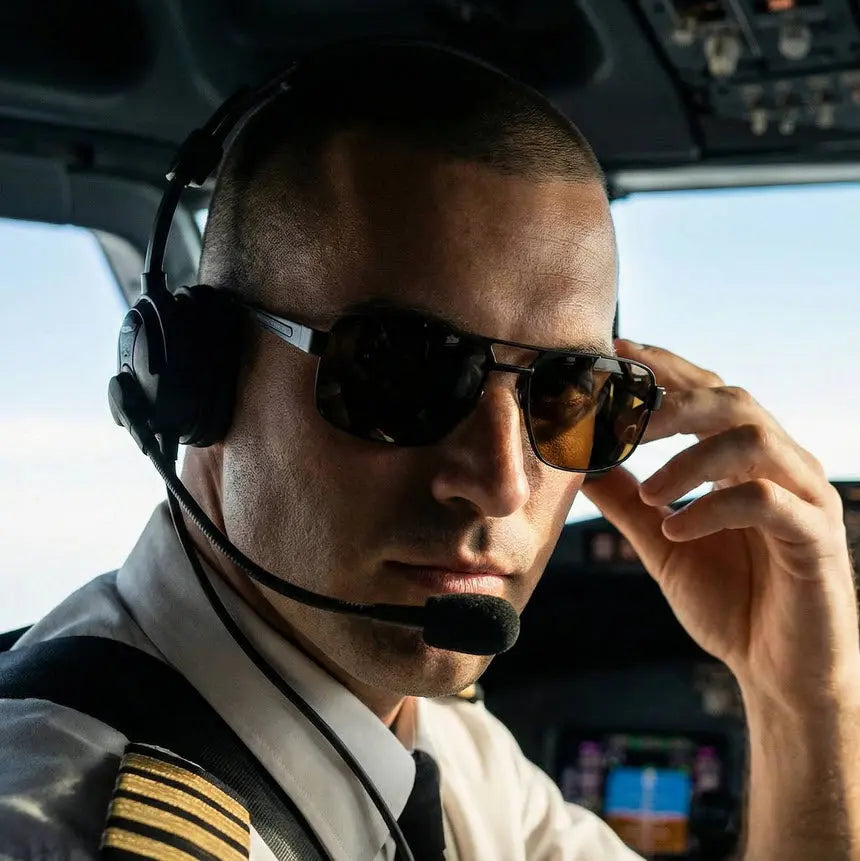
A pilot wearing AO Original Pilot sunglasses with a passenger wearing a pair of AO General sunglasses.
Flying an airplane is a serious business! Pilots go through a great deal of training before they are turned loose to fly an airplane as the pilot in command. Some new pilots are only interested in learning how to fly in order to purchase their own small, private aircraft, which they will fly for fun and travel. Others are seeking a career in aviation as a pilot.
Many pilots continue their training as they focus on a career as a professional pilot flying for an airline, a corporation, or an air freight or charter company. No matter what the reason why they learn to fly, it becomes a passion and a way of life for them. As they continue flying, they learn the basics of how to properly aviate, navigate and communicate.
No matter whether pilots are interested in pleasure or professional flying, they will soon create what we pilots call our flight bag. As we gather experience and learn what tools we need to have in order to make safe flights, over time we add more and more items to our flight bags. Those items are important to help us fly safely; things like headsets, charts, maps, rulers, logbooks, etc. One of the most important items we carry are sunglasses, and most of the time we carry more than one pair of sunglasses.
Why Multiple Pairs of Sunglasses?
As pilots begin to build flying time (hours), they encounter many kinds of light due to the changes in the weather. Some days are bright and sunny, other days are cloudy, and some days they are even shrouded in fog, snow or rain. Whatever the weather conditions, one thing is certain: the available light will be different depending upon the type of weather.
For example, if we are flying on a bright, sunny, cloudless day we will encounter very bright sunlight, and it can cause pain and make you tired by the end of your flight. If it is a cloudy day, there is usually some haze and lower light conditions, making it more difficult to see other aircraft and hazards. And, at times when there is fog, rain or snow, it can be very difficult to see anything well at all.
This is why we carry more than one pair of sunglasses. For bright sunny days with no clouds, we will need a pair of sunglasses with a smaller amount of VLT, or Visible Light Transmittance, to protect our eyes. VLT refers to the percentage of light that the sunglass lens will allow through to our eyes. On cloudy days we need more light, so we would wear a pair of sunglasses with a higher percentage of VLT. And for fog, rain or snow we will want even more light, or an even higher VLT percentage of light to reach our eyes.
So, it is important that pilots understand the issue of light conditions, and to use that knowledge when choosing a pair(s) of sunglasses. The problem is, however, that not every manufacturer of sunglasses provides the VLT information about their sunglass lenses. In addition to VLT, when it comes to sunglass lenses there are even more things to consider.
For example, there are many types of lens materials used for sunglass lenses, ranging from mineral glass, polycarbonate, polyamide (nylon), and CR-39 (plastic). Each lens has its advantages and disadvantages. Below is a chart outlining some of those differences:
| Material | Clarity | Weight | Impact Resistance | Scratch Resistance |
| Glass | Highest | High | Low | Highest |
| Polyamide/nylon | High | Lowest | High | High |
| Polycarbonate | Moderate | Light | High | Moderate |
| CR-39 | High | Moderate | Low | Moderate |
Looking at the chart above, it should be clear that the best lenses for pilots are glass, followed by Polyamide and Polycarbonate. However, glass lenses are heavier and for some pilots that is a problem with the extra weight on their nose, but to choose lighter lenses we have to give up what is probably the most important thing: clarity of vision.
What About Polarized Sunglasses?
No doubt all pilots have heard, read or been told that polarized lenses are not a good choice for pilots. But what are the facts? Because one of the rules pilots live by is the "see and be seen" rule for flight. This is especially important for non-controlled air space, the air space used mostly by private pilots who fly airplanes that generally fly below 10,000 feet.
Polarized lenses utilize a specialized chemical filter designed to selectively block horizontal light waves while allowing vertical light waves to pass through. This filter is typically a thin film of polyvinyl alcohol (PVA) plastic that has been stretched to align its molecules into long, parallel chains. The material is dipped in iodine, which attaches to these aligned chains. This creates a microscopic structure that allows valence electrons to move easily along the polymer chains, absorbing light vibrating parallel to them.
Modern jet aircraft fly at high altitudes (20,000 to 40,000 feet plus), and require laminated and heated windscreens because of aircraft pressurization. Sunglasses with polarized lenses will be interfered with by laminated windscreens, which will show visible striations or stress patterns (birefringence) that look like oil slicks or rainbow colors. Heated windscreens can display intense color strikes when seen through polarized lenses, sometimes making it impossible to see through the windscreen clearly.
Polarized lenses use filters to make them polarized, and when those filters interact with laminated windscreens they can create distracting artifacts or dark spots that obscure the pilot's view. For this reason, polarized sunglasses are not recommended for pilots flying jet aircraft, but they shouldn't cause any problems for pilots flying at altitudes that don't require pressurization.
What About Non-Polarized Sunglasses?
Unlike polarized sunglasses that contain a filter that interfere with the thick, laminated and heated windscreens in jets, non-polarized lenses do not have the filter which is used to only reduce glare and the overall brightness of sunlight. Non-polarized sunglasses are reasonably simple in construction and therefore lighter in weight.
This is why non-polarized lenses are recommended for pilots, particularly pilots flying jet aircraft with thick, laminated and heated windscreens. They provide excellent visual acuity, and enhance the ability of pilots to adhere to the "see and be seen" FAA rule. And, as a general rule, glass lenses are preferred because they provide the highest clarity when searching the skies for danger.
Non-polarized sunglasses use a number of coatings to address issues like glare, reflection, and ghost images, particularly when used on the back side of sunglass lenses. The non-polarized lenses can be made with special coatings to solve the interference problems like those described for polarized sunglasses earlier in this post. But pilots flying in the lower altitudes may still prefer polarized sunglasses due to the anti-glare properties of the lenses.
Knowing the differences between polarized and non-polarized sunglasses can help pilots select the best option and quality to meet their needs.
Other Tips for Choosing Pilot Sunglasses
When selecting the most appropriate sunglasses, pilots should consider the following:
UV Protection: Look for sunglasses that provide 100% blockage of all UVA and UVB rays so that your eyes are protected from the sun's harmful rays. Consider VLT, and choose the VLT percentage that will work best for you in the areas you fly in. And consider the frame construction of the sunglasses.
Lightweight frames with a secure fit reduce the risk of discomfort on your nose and ears when flying for prolonged periods. If you wear a pair of modern, tight-clamping headsets, then be sure and consider the thickness of the sunglass temples. Thick temples can allow external noise to interfere with your communication with Air Traffic Control.
Lens color is also another item to consider. Grey lenses are preferred among pilots because they decrease brightness while still allowing natural color. G-15, or green lenses, offer slightly better contrast, while brown or bronze lenses provide the best contrast, particularly in low light conditions.
Pilots need sunglasses that are well built, and which will tolerate heavy wear, handling, and travel. Purchasing high-quality sunglasses will enhance your safety and comfort while flying.
Choosing Aviator Sunglasses for Pilots
Aviator sunglasses are a popular pick for pilots for a number of reasons: they have wide eye coverage, and they have a timeless standard design. The rectangular shape matches the head well and prevents sun from coming in at many angles, with the shade's wide coverage. Aviator sunglasses are offered both polarized and non-polarized. There are brands such as AO Original Pilot and Scheyden Pilot sunglasses that offer premium aviator sunglasses built especially for pilots and outdoor lifestyle enthusiasts.
Other brands like Method Seven specialize in aviator style sunglasses for men and women which feature mineral glass lenses with incredible visual acuity, while >Eagle Eye Optics offer cost-conscious sunglasses featuring hinged frames and both polarized and non-polarized lenses. And then there are the mid-range pilot sunglasses like Flying Eyes which feature razor thin frames and temples with multi-colored, non-polarized, polycarbonate lenses.

Written by John M. White

Search this site
Recent Posts
-
The Perfect Gift Ideas for Pilots: From Sunglasses to Aircraft Models
October 03, 2026 -
Why Are Aircraft Wood Models Popular Among Collectors?
October 03, 2026 -
Jimmie Angel, Aviator, Explorer, Prospector
September 19, 2026 -
Imagine Finding Yourself In A Freefall from 28,000 Feet!
July 31, 2026

1 comment
Are frames with 135mm temple pieces available?
Danny Cherry
Leave a comment
This site is protected by hCaptcha and the hCaptcha Privacy Policy and Terms of Service apply.