
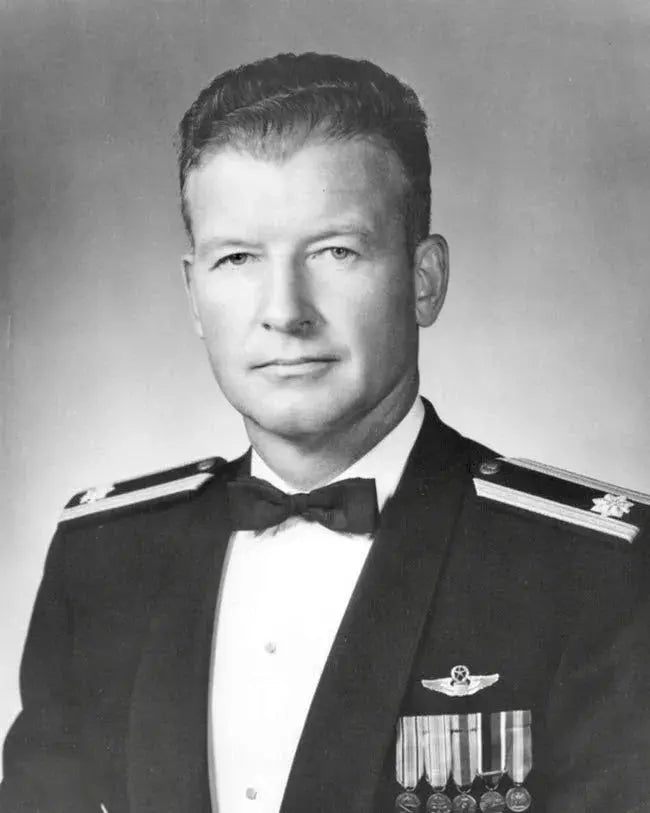
Lt. Christopher Magee
One of the things I enjoy most is researching interesting pilots, ranging from the original pioneers of aviation through the pilots flying in the complex world of aviation today. Many times I run across what seems to be a simple story, only to discover that the deeper I look, the more fascinating the story becomes.
This is one of those stories.
You may recall one of my earlier posts about John Gillespie Magee, the author of the famous aviation poem "High Flight." The two were distant cousins, both from the line of a great uncle to both of the Magees, and was a powerful political boss in Pittsburgh, PA, by the name of Christopher Magee.
Christopher Lyman Magee was born in Omaha, Nebraska, on June 12, 1917, to Fred and Marie Magee. In 1918, the family moved to the South Side of Chicago where Fred took a job with the grain market exchange. Young Chris Magee attended grade school at Saint Ambrose Parish and high school at Mount Carmel High School, graduating in 1935.
Christopher Lyman Magee picked up the nickname C.L. in his youth, and throughout his high school days Chris Magee balanced his love of sports with his passion for reading and learning, and he maintained that same love of excercise and learning throughout his adult life.
After graduation from high school Magee made a committment to himself, to develop his muscles, but at the same time getting into trouble with bookies. After aimlessly wandering about South Chicago for three years, Magee finally decided to enroll at the University of Chicago in 1938. While attending college Magee played football as a tight end with the University of Chicago Maroons, and he also excelled in track and boxing.
Soon, in 1939, war broke out in Europe, causing Chris Magee to lose focus on his academic studies. As he learned more and more about the war an itch to get into the fight soon consumed Magee. In January of 1940, Chris Magee's sense of adventure, and his outrage at the German war machine, led him to hitchhike with two friends down to New Orleans. The goal was to get passage as a deck hand on a freighter bound for England, but, it was not to be. Soon Magee and one of his friends hitchhiked back to Chicago.
When he got back to Chicago, he learned that the Canadians were inviting Americans to join the fight by encouraging them to join the RCAF (Royal Canadian Air Force). So, impulsive as usual, Magee travelled to Windsor, Ontario, to join up. Once again he ran into a roadblock. The RCAF required a college degree in order to allow Americans to enlist for pilot training.
Disappointed, but still wanting to join the fight, Chris Magee went back to Chicago where he devoted himself to studying hard to pass the 2-year college American equivalency test. He passed the test in 1940, and was accepted into the U.S. Army Air Corps cadet flight program. Again, impatient as ever, Magee discovered that the flight training would not begin until March of 1941!
I don't know if Chris Magee had ever met his distant cousin John Gillespie Magee, Jr., but Chris decided to return to Canada and apply with the RCAF for pilot training. Once again, impetuous Chris Magee learned that his American equivalency test was not accepted by the Canadians, and that they required two full years of actual college participation were required. However, Magee was told that the RCAF would also accept him if he had 35 hours of logged flying time.
So, true to form, Chris Magee decided to take his slot for flight training with the U.S. Army Air Corps cadet flight program in March of 1941. However, he devised a plan where he would only stay in the U.S. Army cadet pilot training program until he had 35 hours of flying time, then truck back North to Canada to join the RCAF. The U.S. Army cadet training program was at the Spartan School of Aeronautics in Tulsa, Oklahoma.
While there he accumulated 25.5 hours of instruction and 10 hours of solo time in the Fairchild PT-19.

A photograph of the WW II Fairchild PT-19 trainer.
Specifications of the Fairchild PT-19 WW II Trainer
- Seats: 2;
- Length: 27 feet 11 inches;
- Wingspan: 35 feet 11 inches;
- Height: 10 feet 6 inches;
- Takeoff weight: 2,800 pounds
- Cruise speed: 184 mph;
- Range: 440 miles;
- Ceiling: 15,300 feet;
- Engine: Ranger L-440-3 200 hp piston powered engine.

Chris Magee in front of a Fairchild PT-19 at the Sparta School of Aeronautics hangar.
As planned, Chris Magee feigned incompetence and washed out of the program. On May 20, 1941, he headed North with his logbook in hand. Finally, after a dirty coal car ride to Toronto, Chris was allowed to enlist in the Royal Canadian Air Force! He was then shipped off by passenger train to the No. 5 Manning Depot where he went through basic training.

A recruiting poster to attract volunteers to join the RCAF in WW II.
The British Commenwealth Air Training Plan (BCATP)
If you have ever known or met a Brit, you will know that they will take their "bloody old time" with whatever they are doing. Think about General Montgomery in World War II. So, much to the surprise of Chris Magee, instead of jumping into an airplane and charging after the enemy, regulation training had to take place first.
After completing his basic training at No. 5 Manning Depot, Magee was sent to serve six weeks on guard duty at an RCAF storage depot. In the lingo of the day, this duty was known as "Tarmac Duty." Any pilot understands what this is. This was followed by attending No. 3 Initial Training School at Victoriaville, Quebec. This is where budding pilots were trained in navigation, theory of flight, meteorology, duties of an officer, algebra, trigonometry, and air force administration. Plus, a four hour physical, decompression chamber training, training in a Link Trainer along with more academics.

A World War II Link Trainer
This was not quite what anxious Chris Magee had in mind! When, if ever, would he get "in the fight?"
December 7, 1941: Pearl Harbor Is Attacked
At last, and as a result of the attack on Pearl Harbor by the Japanese on December 7, 1941, the United States declared war on Japan, Germany, and Italy. But, Magee had decided to stay on track with the RCAF as the quickest way for him to get into the war. Because of Chris's aptitude and flying time, he was chosen to go to No. 21 Elementary Flying Training School (ETS) at RCAF Station Chatham, near the town of New Castle, in New Brunswick, Canada.
Here, Magee gained 50 hours of basic flight instruction in the Fleet Finch biplane trainer in 8 weeks. In the winter, the aircraft were fitted with skis, and the weather was terrible. The training was performed by civilian flight instructors from the Moncton Flying Club. However, pretty soon American recruiters were on the prowl through RCAF pilot training camps looking for American volunteers to come back home to the United States.

The Hart Finley Fleet Finch trainer in World War II.
While the Americans could make Magee's wishes come true, the RCAF told him that he would go where they told him to go, what they wanted him to do, and no questions asked! So, typical Magee, after some 300 days of this in Canada, Magee headed South to Naval Air Station Atlanta in DeKalb County, GA, where they promised he would become a U.S. Marine Corps fighter pilot.

A U.S. Navy/Marine Corps Vought F4U Corsair on the ramp at Naval Air Station Atlanta in World War II.
After four months of intense flight training as a naval flight cadet flying the North American T-6 Texan, Magee transitioned to the U.S. Marine Corps, at which point in time he was awarded his gold wings in late November 1942, and a commission as a 2nd Lt. From there he went to the fighter operational training unit at Cecil Field, Florida, where he began training in the Grumman F4F Wildcat.
By this time, however, the Wildcat was somewhat obsolete as a carrier-based fighter in the South Pacific. but as a transitional naval fighter trainer it was outstanding. Magee then was sent back to Chicago to undertake carrier landing qualifications aboard the paddle wheel training carrier, the USS Wolverine:

The USS Wolverine in Lake Michigan near Chicago for carrier landing training in WW II.
On June 23, 1943, following three years and five months trying to get "in the fight," 2nd Lt. Christopher Lyman Magee was finally in the war. On the island of Espiritu Santo he began his transition into the Chance Vought F4U Corsair, the ultimate single engine fighter for a man impatient to his metal in air-to-air aerial combat.
For the next month Magee trained hard, accumulating nearly 70 hours in the Corsair, but yet to engage the enemy in a dog fight. Not really a fighter pilot yet, the squadron suddenly was disbanded, and the pilots placed in a pool of unattached pilots. Quickly a rumor started that these pilots were scallywags, brawlers, drunkards, and pilots no one else wanted. Nothing could have been further from the truth! These men turned out the have great character, a desire to serve and excel, and help win World War II.
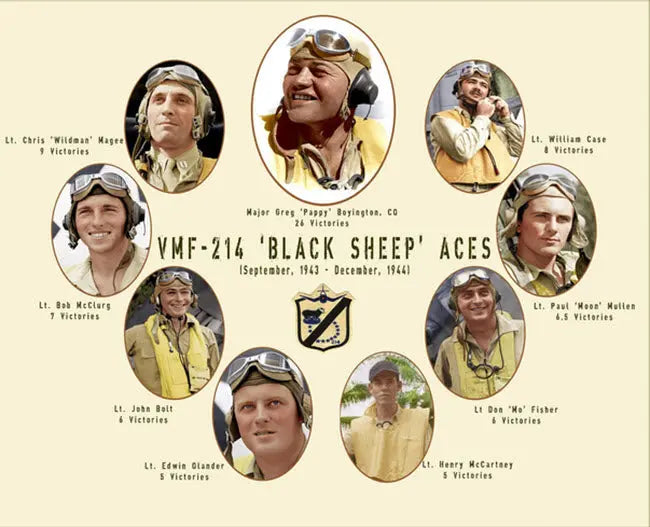
Instead, he and a squadron's worth of young fighter pilots were selected to join U.S. Marine Corps squadron VMF-214. This squadron was commanded by the brash, pugilistic, and over competent combat ace from Idaho: Maj. Gregory "Pappy" Boyington. Perhaps you have heard of him and his pilots. They were given the nickname "Black Sheep."

Group photo of VMF-214 with Chris L. Magee in the front row, fourth from the left.
Specifications of the Chance Vought F4U Corsair:
- Single seat fighter;
- Length: 33 feet, 8 inches;
- Wingspan: 40 feet, 11 inches;
- Height: 14 feet, 9 inches;
- Powerplant: Pratt & Whitney 2,850 hp Pratt & Whitney Double Wasp radial engine
- Maximum speed: 447 mph;
- Ceiling: 44,000 feet;
- Range: 1,000 miles;
- Armament: 6 each 0.50 calibre machine guns, 4 each 20mm calibre cannons, 2,000 oounds of bombs.
During the late 1943 island-hopping campaign up the Solomons,VMF-214 flew out of bases so far forward that they were often behind Japanese lines. (Navy Seabees had started the reconstruction of desolate, bomb-pocked Munda while the enemy still held the far end of the strip.) On their first tour, the Black Sheep suffered an almost 40 percent casualty rate, including one pilot shot down in a friendly-fire duel with Navy PT-boats.

Lt. Chris Magee of the Black Sheep Squadron.
Yet, they overflew Bougainville so regularly that the Japanese, via radio, dared Boyington by name to come down and brave the anti-aircraft fire; instead he taunted the Japanese Zero pilots telling them that they should come up and fight.

Lt. Chris Magee sitting in his F4U Corsair waiting for the launch order.
The unit packed up what Corsairs they could muster and moved northwest along the edge of the Coral Sea to Guadalcanal and then a short hop further northwest to the Russell Islands, there to ready for combat and build a working squadron. It was from here that finally, after nearly 44 months of trying, Chris Magee rose from the recently completed coral dust runway on the island of Banika along with 19 other Black Sheep Corsairs on his very first combat mission, escorting 150 dive and torpedo bombers attacking Japanese bases in Bougainville.
During this mission, the new pilots of VMF-214 shot down 11 with eight “probables”. It was an auspicious start to spectacular record by a legendary squadron. Magee and 214 left the Russells the very next day after just this one mission, moving even closer to the enemy at a crude forward base called Munda on the island of New Georgia.
Lieutenant Chris Magee had likewise been flummoxed by the speed of air combat: “All I could do was keep spinning my neck and looking around…everything was happening so fast.” Called “Maggie” (though rarely to his face, as he was a dedicated weightlifter and fitness fanatic), Magee plunged from 13,000 feet into a pack of Aichi D3A2 “Val” dive bombers attacking a U.S. convoy. “The Japanese were going into a straight dive, so I headed into the dive with them,” he recalled.
“Of course, by then the American antiaircraft fire was all around us, but you don’t even think of that….The Vals kept going down, and I kept in there, firing.” By the time they pulled out above the water, he had splashed two, and a third probable. Then he heard bullets striking his plane “like a hail storm on a tin roof.” The Vals’ escorts, Japanese A6M Zeros, always slow in a dive, had caught up with Magee. Magee made it back to base with 30 bullet holes in his Corsair. He was recommended for a Navy Cross, and his nickname was changed to “Wild Man.”
One of the pilots, John Bolt, even flew an unauthorized one-man air raid on Tonolei Harbor, making two strafing runs on troop transports and boat traffic. “I was only taken under fire from one gun,” he reported to a furious Boyington on his return, adding that its 20mm tracers “just floated by.” Despite his CO’s ire, Bolt received a congratulatory telegram from no less than Admiral William “Bull” Halsey, plus the Distinguished Flying Cross. He would eventually earn a Navy Cross as well.
In early September near Choiseul, Salomon Islands, he spotted a 70-foot long barge. Magee displayed superb flying ability by bringing out an unauthorized grenade in the cockpit, slid back the canopy, pulled the pin with his teeth and threw the grenade on the barge, setting it on fire. On 17 October 1943 over Kahili Airdrome, he valiantly engaged a superior number of Japanese fighters, which attempted to intercept American forces, andsucceeded in shooting down five Japanese fighters.
During two six-week combat tours, Magee's record was a total of nine combat vistories, making him the second highest scoring ace among the Black Sheep squardon - behind Pappy Boyngton's incredible 26 victories. Even though they were in existence for just four months, the squadron was one of the most aggressive, well-led and successful units in the south Pacific during the Second World War.
Of the original 28 pilots of the Black Sheep squadron, three had been trained by the RCAF: Chris "Wildman: Magee, Bill "Junior" Heier and Don "Deejay" Moore. Sadly, on January 3, 1944, Pappy Boyington was shot down by a Jap Zero over Raboul; and wound up being captured by a Japanese submarine. He then spent 20 months as a prisoner of war until his release in August of 1945.
Magee’s superior fighting skills and his fearlessness in the air earned him many decorations including the Navy Cross, Bronze Star for Valour, numerous Battle Stars and Marine Corps Achievement Medals as well as two Purple Hearts. The citation that accompanied the award of his Navy Cross (an American award for valour second only to the Congressional Medal of Honor) reads:
"The President of the United States of America takes pleasure in presenting the Navy Cross to First Lieutenant Christopher Lyman Magee (MCSN: 0-16480), United States Marine Corps Reserve, for extraordinary heroism and distinguished service in the line of his profession as a Pilot of a Fighter Plane attached to Marine Fighting Squadron TWO HUNDRED FOURTEEN (VMF-214), Marine Air Group ELEVEN (MAG-11), FIRST Marine Aircraft Wing, in aerial combat against enemy Japanese forces in the Solomon Islands Area from 12 September 1943 to 22 October 1943. Displaying superb flying ability and fearless intrepidity, First Lieutenant Magee participated in numerous strike escorts, task force covers, fighter sweeps, strafing missions and patrols. As member of a division of four planes acting as task force cover on 18 September he daringly maneuvered his craft against thirty enemy dive bombers with fighter escorts and, pressing home his attack with skill and determination, destroyed two dive bombers and probably a third. During two subsequent fighter sweeps over Kahili Airdrome on 17 and 18 October he valiantly engaged superior numbers of Japanese fighters which attempted to intercept our forces and succeeded in shooting down five Zeros. The following day, volunteering to strafe Kara Airfield, Bougainville Island, he dived with one other plane through intense anti-aircraft fire to a 40-foot level in a strafing run, leaving eight enemy aircraft blazing. First Lieutenant Magee’s brilliant airmanship and indomitable fighting spirit contributed to the success of many vital missions and were in keeping with the highest traditions of the United States Naval Service."
Not too long after the end of the war, while Chris was still with VMF-911, he got some good news about the commander of his old Black Sheep squadron—Greg Boyington had been confirmed still alive and freed from a Japanese POW camp and was being flown home to San Francisco. Twenty-one of the Black Sheep pilots were still stationed somewhere on the West Coast and they were rounded up by the Marine Corps to form a welcoming party for Boyington’s triumphant arrival at Naval Air Station Alameda in Oakland.
And what a party it was—covered by a large contingent of the press corps including a reporter and photographer from LIFE magazine. It would be the last high point in Chris Magee’s military career. Not long after Boyington’s homecoming bash, Chris Magee opted to resign from the Marine Corps rather than fly with the squadron to Okinawa. He didn’t just want to fly fighter aircraft, he wanted to fight with them in real combat against real enemies. Peacetime flying held no interest for him.
Adrenaline Rush Syndrome
After Magee was promoted to Captain, he returned stateside before the war ended, and was billieted to Marine Corps Air Station Cherry Point, North Carolina. Here he met, and married, Molly Cleary. When he was released from service and returned to Chicago with his young family, Magee started participating in other high risk activities. Apparently they were not aware of Adrenaline Rush Syndome, officially never recognized until after the Vietnam War.
Soon Magee became a bearded, bandana-wearing hippy looking for excitement. Soon he was smuggling alcoholic beverages, and became involved in becoming a courier for a group of shadowy businesmen between Latin America and the U.S. In 1948 Magee joined Israel's 101st Fighter Squadron, but never encountered an enemy aircraft. Upon returning stateside he discovered that his wife Molly had divorced him and moved off with their two young children, never to be seen again.
Still seeking that adrenaline rush, Magee robbed three banks, was captured, convicted and sentenced to fifteen years in prison. He was released in 1967 after nine years in prison, and returned to the Chicago area. He quietly and almost anonymously worked as an editor and reporter for a local Chicago newspaper.
Magee died on December 27, 1995, at the age of 78, and is buried in Arlington National Cemetery in Virginia.
Postscript from “One Who, Like His Age, Died Young”
A few years after the war, the wreck of a U.S. Marine Corps Corsair fighter was found in the interior jungle of New Ireland, in the Solomon Islands, by a former Royal Australian Coast Watcher. A jungle kit was found in the cockpit of the aircraft, along with survival gear, a wax-sealed, fungus resistant plastic folder containing a box of .45 automatic and some ammunition. along with a sheet of paper that read:
"I have skimmed the ragged edge of lightning death
And torn from bloody flesh of sky a thunder song.
Across the nakedness of virgin space
I’ve blistered my frozen hand in feathered ice
And dared angelic wrath to smash
The snarling will of my demon steed.
Far above the sun-glint on winded spume,
High executor of laws no man has made,
I’ve welded Samurai knights into fiery tombs
And hurled them down like the plumed Minoan
Far down the searing heights to punch
Their livid crates in the sea.
‘Enemies,’ you say. They were not mine.
More than blood brothers, I swear,
With tawny skin and warrior eye.
Bushido-bred for hell-strife joy.
Much closer my kin, may race than those
Who cud-chew their lives can ever be.
‘War-lover,’ you say, ‘sadist, psychotic’—
That sick cycle of canned clichés masking
Your lust for eternity fettered to time.
Go, epigonic pygmies, make peace with hell,
Drag the myths of our ancient might
Through the miserable muck of a cringer’s dream.
What could you know
Who have never heard
The soaring song of the Valkyries,
Felt thunder-gods jousting with livid peaks:
You who have never dared to walk the razor
Across the zenith of your peevish soul?"
This was one of Chris Magee's published poems. Chris "Wildman" Magee, cousin to John Gillespie Magee, was clearly driven to suceed as a fighter pilot, and having conquered his airplane became a fearless, agressive warrior of the sky in World War II. I hope his soul found peace and rest.
I hope you enjoyed this trip through some of the history of sunglasses. If you enjoyed this trip, and if you are new to this blog, sign up to receive your own weekly blog post here: Subscribe here!
Until next time, keep your eyes safe and focused on what's ahead of you, Hersch!




Written by John M. White

Search this site
Recent Posts
-
The Perfect Gift Ideas for Pilots: From Sunglasses to Aircraft Models
October 03, 2026 -
Why Are Aircraft Wood Models Popular Among Collectors?
October 03, 2026 -
Jimmie Angel, Aviator, Explorer, Prospector
September 19, 2026 -
Imagine Finding Yourself In A Freefall from 28,000 Feet!
July 31, 2026
Leave a comment
This site is protected by hCaptcha and the hCaptcha Privacy Policy and Terms of Service apply.