
The Secret Code
On a windy April 11th, 1929, in Preston, Maryland, a young boy, the son of Robin Smith Harris and Early Joseph Harris, named Carlyle Smith Harris, arrived in the loving arms of his mother and father.
As he grew up he acquired the nickname of "Smitty", and along with his brother Joseph "Joe" Harris, the family enjoyed life in their Maryland home. As hw was growing up he attended the Charlotte Hall Military Academy near the border of Calvert and Charles counties.
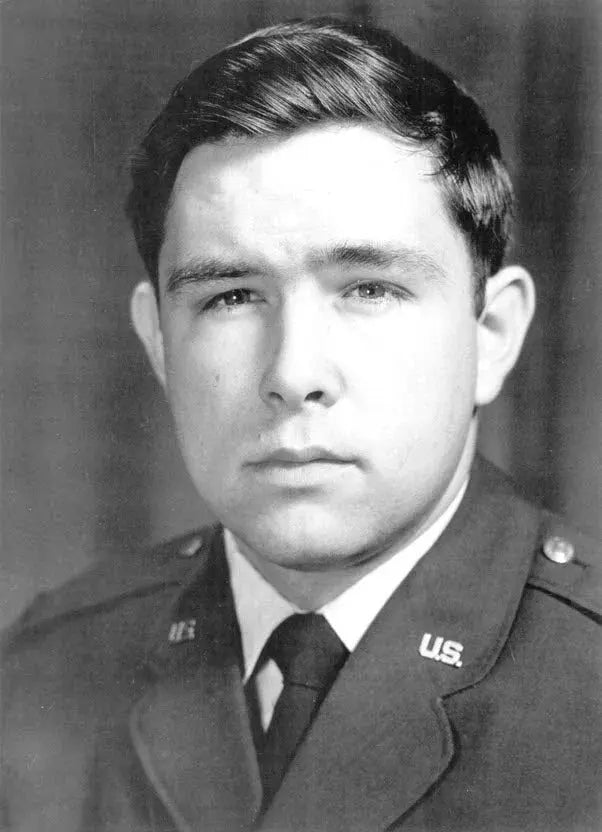
"Smitty" had dreamed of flying as a young lad, so upon graduation from the Charlotte Hall Military Academy he pursued his dream by joining the US Air Force. He enlisted into the Air Force and after completion of basic training advanced toward his goal of becoming a pilot.
As an enlisted man "Smitty" atained the rank of sergeant before he was commissioned as a Second Lieutenant. In 1953, he earned his Air Force pilot wings and trained in the T-33 Shooting Star and the F-84 Thunderjet.
His first operational assignment was as an F-86F Sabre pilot with the 45th Day Fighter Squadron at Sidi Slimane Air Base in French Morocco. Upon completion of his tour there he became an instructor pilot at Greenville AFB, Mississippi amd Bainbridge AFB in Georgia.
While at Bainbridge Air Force Base in Georgia, a young woman named Louise Lambert agreed to ride the 40 miles from Tallahassee, Florida, to Bainbridge Air Base in Georgia with a boy she had been dating. "He wanted to go and get some tips from some pilot," she said. "I agreed to ride with him."
When they got to Bainbridge AFB her date introduced her to a pilot by the name of "Smitty" Harris. After their visit "Smitty" decided to call her for a date, which was followed up by many more dates.
Upon becoming a captain, Harris flew the F-100 Super Sabre and F-105 Thunderchief aircraft at McConnell AFB, Kansas. This was followed by serving as the Chief of Promotions and Flying Status Branch located at Headquarters Air Training Command, Randolph Air Force Base, Texas.
By 1965, the Harris family — Smitty, Louise, 4-year-old Robin and 3-year-old Carolyn — relocated to Kadena Air Base in Okinawa, Japan, where Smitty Harris, Age 36, would fly the F-105 fighter-bomber.

A flight of Republic F-105 Thunderchief aircraft during the Vietnam War.
Republic F-105 Thunderchief Specifications:
- Length: 64 feet 4.75 inches;
- Wingspan: 34 feet 11.25 inches;
- Height: 19 feet 8 inches;
- Empty weight: 27,500 pounds;
- Maximum weight: 36,637 pounds;
- Crew: 1 or 2;
- Propulsion: One Pratt & Whitney J75-P-19W afterburning turbojet, 26,500 pounds of thrust with afterburner and water injection;
- Combat radius: 780 miles;
- Max speed: Mach 2.08 (1,372 mph);
- Ceiling: 48,500 feet;
- Armament:
- Guns: One 20mm M61 Vulcan cannon with 1,028 rounds
- Bombs/Rockets: Up to 14,000 pounds of ordnance including nuclear weapons, AIM-9 Sidewinder, and AGM-12 Bullpup missiles;
- Bombs are carried in the bomb bay and on five external hardpoints.
The Vietnam War
Upon arrival at Okinawa, Japan, Capt. Harris received briefings on what he would be doing, and one of them was a discussion on the Code of Conduct that had been created after the Korean War. Then Captain Harris began flying combat missions over Southeast Asia with the 67th Tactical Fighter Squadron based at Kadena Air Base on Okinawa.
On April 3, 1965, "Smitty" was assigned to a mission to destroy a bridge at Ham Rong, a bridge called the "Dragon's Jaw," an important bridge that was a strategic passage for supplies and reinforcements being sent to the Viet Cong who were conducting operations in South Vietnam.
What follows is information provided by a U.S. Air Force document regarding the April 3rd and 4th missions in 1965, the fifth and sixth missions flown by Capt. Carlyle S. "Smitty" Harris:
"The Thanh Hoa Railroad and Highway Bridge, spanning the Song Ma River, is located three miles north of Thanh Hoa, the capital of Annam Province, North Vietnam. It is a replacement for the original French-built bridge destroyed by the Viet Minh in 1945 - they simply loaded two locomotives with explosives and ran them together in the middle of the bridge.
In 1957, the North Vietnamese rebuilt the bridge. The new bridge, completed in 1964, was 540 feet long, 56 feet wide, and about 50 feet above the river. The Vietnamese called it Ham Rong (the Dragon's Jaw), and Ho Chi Minh himself attended its dedication.
The bridge had two steel thru-truss spans which rested in the center on a massive reinforced concrete pier 16 feet in diameter, and on concrete abutments at the other ends. Hills on both sides of the river provided solid bracing for the structure. Between 1965 and 1972, eight concrete piers were added near the approaches to give additional resistance to bomb damage.
A one-meter guage single railway track ran down the 12 foot wide center and 22 foot wide concrete highways were cantilevered on each side. This giant would prove to be one of the single most challenging targets for American air power in Veitnam. 104 American pilots were shot down over a 75 square mile area around the Dragon during the war.
(Only the accounts of those specifically known to be involved in major strikes against the bridge are given here. Some losses were aircraft involved in operations against other targets. Note also, that because aircraft came in on this target from a wide geographic area, some personnel lost outside the 75 mile range may have been inadvertently overlooked in this study.)
In March 1965 the decision to interdict the North Vietnamese rail system south of the 20th parallel led immediately to the April 3, 1965 strike against the Thanh Hoa Bridge. Lt.Col. Robinson Risner was designated overall mission coordinator for the attack. He assembled a force consisting of 79 aircraft - 46 F105's, 21 F100's, 2 RF101's and 10 KC135 tankers. The F100's came from bases in South Vietnam, while the rest of the aircraft were from squadrons TDY at various Thailand bases.
Sixteen of the 46 "Thuds" (F105) were loaded with pairs of Bullpup missiles, and each of the remaining 30 carried eight 750 lb. general purpose bombs. The ircraft that carried the missiles and half of the bombers were scheduled to strike the bridge; the remaining 15 would provide flak suppression. The plan called for individual flights of four F105's from Koran and Takhli which would be air refueled over the Mekong River before tracking across Laos to an initial point (IP) three minutes south of the bridge.
After weapon release, the plan called for all aircraft to continue east until over the Gulf of Tonkin where rejoin would take place and a Navy destroyer would be available to recover anyone who had to eject due to battle damage or other causes. After rejoin, all aircraft would return to their bases, hopefully to the tune of "The Ham Rong Bridge if falling down.
The last flight of the day, led by Capt. Carlyle S. "Smitty" Harris, adjusted their aiming points and scored several good hits on the roadway and super structure. Smitty tried to assess bomb damage, but could not because of the smoke coming from the Dragon's Jaw. The smoke would prove to be an ominous warning of things to come.
When the smoke cleared, observer aircraft found that the bridge still spanned the river. Thirty-two Bullpups and ten dozen 750 pound bombs had been aimed at the bridge and numerous hits had charred every part of the structure, yet it showed no sign of going down. A restrike was ordered for the next day.
On this day, April 4, 1965, Capt. Carlyle "Smitty" Harris was flying as call sign "Steel 3". Steel 3 took the lead and oriented himself for his run on a 300 degree heading. He reported that his bombs had impacted on the target on the eastern end of the bridge.
Steel 3 was on fire as soon as he left the target. Radio contact was garbled, and Steel Lead, Steel 2 and Steel 4 watched helplessly as Smitty's aircraft, emitting flame for 20 feet behind, headed due west of the target. All flight members had him in sight until the fire died out, but observed no parachute, nor did they see the aircraft impact the ground.
Smitty's aircraft had been hit right over the target, by what he believed was a 37 MM AA round. It was not until much later that it would be learned that Smitty had been captured by the North Vietnamese."
He was soon captured, at the time was 36 years old with a wife, two young daughters and a third baby on the way, when his F-105 was shot down over North Vietnam.. He was the sixth American Prisoner of War captured in North Vietnam and would spend nearly eight years in various prison camps around Hanoi, including the "Hanoi Hilton."

An aerial view of the "Hanoie Hilton" in North Vietnam during the Vietnam War.
A Prisoner of War in North Vietnam
It was not until much later that it would be learned that Smitty had been captured by the North Vietnamese. Smitty was held prisoner for 8 years and released in 1973. He survived years of interrogation, torture, solitary confinement, and malnutrition, during which he went from 160 pounds to an incredible 90 pounds when he was released.
During his time in North Vietnam "Smitty" was originally moved from one POW camp to another, eventually ending up in downtown Hanoi at the infamous Hanoi Hilton prison.
Over time the North Vietnamese captured more and more American pilots who had been shot down and captured by the North Vietnamese soldiers, including the former U.S. Senator from Airizona, John McCain, a son of Admiral John S. McCain Sr.

On his 23rd bombing mission over North Vietnam, his plane was shot down. This Oct. 26, 1967, photograph shows Hanoi residents recovering him from the city's Truc Bach lake. McCain said that upon capture he was struck, kicked, and bayoneted by several hundred Vietnamese before they were chased off by a nurse.
Before creating the Hanoi Hilton the North Vietnamese held the prisoners they captured in a variety of 14 POW camps in or around Hanoi. Conditions varied between the camps, and prisoners were sometime transferred back and forth between them.

A map of the POW camps in and around North Vietnam during the Vietnam War.
Following the Code of Conduct for captured U.S. prisoners, they used morse code to communicate between cells in an effort to keep up morale, and to encourage each other to resist giving the enemy any information beyond name, rank, birth date, and serial number.
In the end, some 591 American POWs were being held in POW camps in North Vietnam. Capt. "Smitty" Harris eventually would up in the Hanoi Hilton and realized that the concrete walls would not allow them to use morse code to communicate with each other.
And this is when Capt. Harris created and distributed his "Tap Code" to enable communication between prisoners in the Hanoi Hilton. Using the code, they could softly tap messages of encouragement to lonely neighbors and pass along resistance policies from their leaders. The code quickly became a lifeline during their internment. It helped the prisoners boost morale, stay unified, communicate the chain of command, and prevail over a brutal enemy.

Capt. Harris beside a copy of the Tap Code that he invented for POWs to communicate with each other by.
Amazingly, Capt. Harris was held prisoner for 8 years from his capture in 1965 to his release in 1973. Fellow POWs credited Smitty with introducing the "tap code" which enabled them to communicate with each other, helping them share their experiences and to cope with the lonely captivity.

A photograph of Capt. Harris speaking to a group after his repatriation back to the U.S.
Carlyle S. "Smitty" Harris spent a year being reunited with his family and recovereing from his ordeal at Maxwell Air Force Base, Alabama. While there he completed the Air War College, was recertified as a pilot, and earned a Master's Degree in Business Administration from Auburn University in Montgomery, Alabama.
He fianlly retired from the U.S. Air Force July of 1979 having received two Silver Stars, three Legion of Merits, a Distinguished Flying Cross, two Bronze Stars with V for Valor, two Purple Hearts, and two Commendation Medals.
After leaving the U.S. Air Force he became a lawyer practicing law in Mississippi, and served on numerous charities and organizations, even serving as a bank executive.
On July 6, 2025, Harris died at the age of 96 while in hospice care, a true patriot and hero.
I hope you enjoyed this trip through some of the history of aviation. If you enjoyed this trip, and if you are new to this newsletter, sign up to receive your own weekly newsletter here: Subscribe here!
Until next time, keep your eyes safe and focused on what's ahead of you, Hersch!




Written by John M. White


Search this site
Recent Posts
-
The Perfect Gift Ideas for Pilots: From Sunglasses to Aircraft Models
October 03, 2026 -
Why Are Aircraft Wood Models Popular Among Collectors?
October 03, 2026 -
Jimmie Angel, Aviator, Explorer, Prospector
September 19, 2026 -
Imagine Finding Yourself In A Freefall from 28,000 Feet!
July 31, 2026

Leave a comment
This site is protected by hCaptcha and the hCaptcha Privacy Policy and Terms of Service apply.