
An American Flying Ace
It was a balmy night on May 29, 1919, in Harvey, Illinois, when George Raymond and Emma McLaughlin Kepford welcomed their new son into the family. As they held the little boy that night they could not have imagined he would one day grow up to be an American Flying Ace in World War II.
They named this young lad Ira Cassius Kepford, and shortly after his birth moved to my hometown of Muskegon, Michigan, on the shores of Lake Michigan. It was a bustling city in 1919 known as "The Lumber Queen of the World," but was slowly moving to a more industrial based community.

A photo of Muskegon after riots in 1919 when the city raised streetcar rates from 6 to 7 cents.
As Ira grew up he acquired the nickname "Ike," and proved himself to be quite an athlete who loved sports of all kinds. By the time Ike reached high school he was making headlines as an outstanding football player at Muskegon High School. Upond graduation he planned on becoming a dentist.
When Ike graduated from high school he decided to attend Northwestern University and study to become a dentist. In 1938 Ike enrolled at Northwestern University, and while attending Northwestern University he continued to play football and study dentistry at the Dental School. While at Northwestern Ike began to develop a keen interest in aeronautics.
While at Northwestern Ike continued to play football, becoming a star for the Northwestern Wildcats team as one of two starting halfbacks. But the war in Europe was already underway, and Ike was convinced that the war was coming to the United States and that he would be drafted to serve in the war.
Rather than wait, Ike enlisted in the U.S. Naval Reserve on August 18, 1941, making a public announcement of his enlistment during halftime at Northwestern's final game of the season on November 22, 1941.
Ike was honorably discharged from the Navy Reserve on April 29, 1942, at which time he was accepted as an Aviation Cadet, U.S.N.R. (United States Naval Reserve). He then attended flight training at the Naval Air Stations in Corpus Christi, Texas, and Miami, Florida.
Ira "Ike" Kepford Takes To The Air
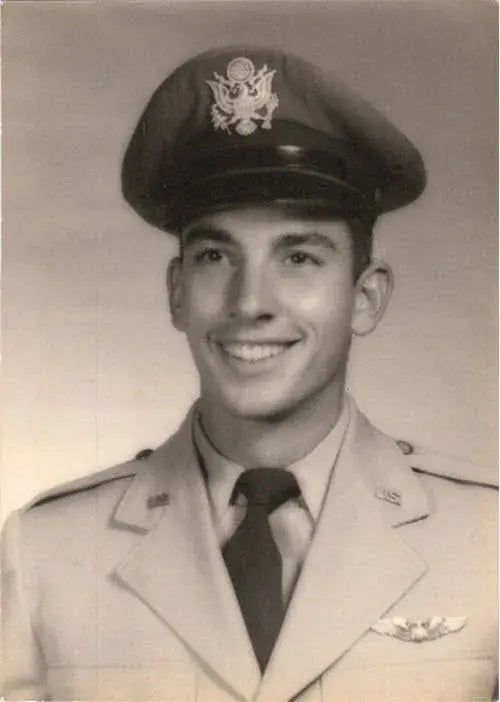
On November 5, 1942, Ira C. "Ike" Kepfrod won his flying wings and was commissioned as an Ensign. Kepford was then assigned to John Blackburn's VF-17 "Jolly Rogers" squadron, a brand new squadron which was scheduled to receive the new F4U Corsairs. The squadron started out with some North American SNJ trainers and F4F Wildcats.
Blackburn wanted to motivate his pilots with a squadron insignia which would live up to the Corsair name, and he chose the skull and crossbones and the name "The Jolly Rogers". Harry Hollmeyer, a squadron pilot, conceived the original design, which was painted on the cowling of the Corsairs that were also known as "hogs."

The members of Blackburn's VF-17 soon enough earned the nickname "Blackburn's Irregulars" because of the trouble they kept getting into while at NAS (Naval Air Station) Norfolk.
The Chance Vought F4U Corsair
 A photograph of Kepford's F4U-1A (BuNo 55995) over the Solomon Islands.
Specifications:
- Crew: 1;
- Length: 33 feet 4 inches;
- Wingspan: 41 feet 0 inches;
- Height: 16 feet 1 inch;
- Powerplant: Pratt & Whitney R-2800-8 Double Wasp 1,000 hp;
- Speed: 417 mph or 362 knots;
- Service ceiling: 36,900 feet;
- Range: 1,015 miles;
- Max Takeoff Weight: 14,000 pounds.
To make things interesting, there was a USAAF Base in Langley, VA, not far from the Norfolk Naval Airbase, a mere 25 miles away. The USAAF pilots there were training in the North American P-51 Mustang, while the Navy pilots were training in the Vought F4U Corsair.
Blackburn's VF-17 pilots were actively seeking to sharpen their skills, using them against servicemen from the other branches of the military. As a result, Blackburn's men eared a reputation as trouble makers at NAS Norfolk, earning them the title of "Blackburn's Irregulars."
So, one day Kepford, while flying the F4U Corsair, encountered a P-51 Mustang, and, of course, a dog fight between the two pilots ensued. I do not know who won this dogfight, but it did result in the move of VF-17 squadron to Manteo, North Carolina, where they completed their training.
Because the F4U Corsair was such a new aircraft, the Navy was concerned about deploying them to an aircraft carrier. At that time, the Grumman F6F Hellcat was being flown off of aircraft carriers, and the Navy was concerned about spare parts for the Grumman F4U Corsair on carriers.
The Battle for Munda Airfield, New Georgia Island
During July and August of 1943 the U.S. Marines landed on New Georgia island at Munda Point in the Soloman Islands in an assault to capture the island and it's airfield. The battle was so fierce that the American soldiers and Marines were pushed to their limits, and it resulted in three Medals of Honor being awarded.

Navajo Native American code talkers who served with the US Marines on New Georgia Island.
As a result of the capture of New Georgia, the Navy decided to send the VF-17 Squadron to the Ondonga, New Georgia, airfield.

Ondonga Airfield on New Georgia Island in the Solomon Island Chain.
Kepford and the rest of the Jolly Rogers were first based at the Ondonga Airfield flying Dumbo escort (Search and Rescue) missions and CAP (Combat Air Patrol) missions, the latter of which proved uneventful.
On November 1, 1943, the United States began the Bougainville Campaign, and the VF-17 pilots were assigned to fly CAP missions for the ships supporting the assault. Blackburn's two divisions of 8 planes each intercepted around 40 enemy aircraft determined to destroy the invasion fleet.
Kepford's division of 4 aircraft were a part of an 8 plane division which searched for four hours without spotting any enemy aircraft. They were then ordered to strafe installations on the Shortland Island before returning to base. Later that day Kepford flew again with the same results, and ended up strafing Shortland Island once again.
However, on November 11, 1943, while VF-17 was flying CAP for Sherman's carrier group while they launched and recovered aircraft from conducting strikes against Rabaul, a mass Japanese counterattack was launched with more than 110 fighters following the returning strike force to their carriers.
Even while outnumbered by roughly 3:1, the Jolly Rogers managed to shoot down 18 enemy aircraft and damage another 6 while suffering only 3 damaged planes and one injured pilot.
During this engagement Kepford managed to shoot down 3 Aichi D3A "Val" dive bombers and one Nakajima B5N torpedo bomber. VF-17's first combat tour was considered a runaway success. From 1 November 1943 through November 29th, the squadron manged to shoot down 47 enemy aircraf with only one pilot lost.
For the period January 26 to March 7, 1944, the VF-17 squadron met stiff resistance from land-based Japanese aircraft operating out of Rabaul. On January 26 and 27, 1944, VF-17 flew escort for U.S. Navy SBD dive bombers and Avenger torpedo attack planes attacking the Lakunai Aerodrome. Each day they encountered around 60 enemy aircraft, and on the second day Kepford shot down two Mitsubishi A6M Zero aircraft, bringing his total to 6 victories and flying ace status.
From January 28, 1944, to January 29th 1944, VF-17 once again found themselves intercepting about 50 enemy aircraft on the first day and another 30 the next day. Kepford flew "roving high cover" with his wingman, Burriss.
They both climed to 30,000 feet while to bombers stayed around 14,000 feet, when they saw a group of Japanese Zeros at 24,000 feet descending on the bombers below. Kepford and Burriss attacked them with Kepford claiming his second 4-victory day.
On January 30, 1944, Kepford led one of four VF-17 divisions flying cover for dive and torpedo bombers attacking Simpson Harbor, New Britain. Enemy fighters from Rabaul were circling the harbor to intercept the bombers.
Blackburn's division was to operate with an altitude advantage aginst the enemy, but Kepford's division was at 15,000 feet when attacked from above by around 12 enemy fighters. Kepford waited for a Japanese plane to break formation to make a gunnery run on a nearby Corsair.
When the Zero turned to tail the Corsair Kepford followed and riddled the Zero's engine and wing root from behind, causing the Zero to catch fire. Kepford had to peel of quickly because of the number of enemy planes around him.
One of these, a Tony, a kawasaki Ki-61 Hien, came at Kepford from the front with the planes' guns - a larger caliber than on Zeros - tore into his right wing causing his ammunition inside the wing to explode.

A Japanese Kawasaki Ki-61 Hien, or Tony, fighter aircraft.
During this whole engagement Kepford continued to fire his guns in the left wing, leaving the Tony on fire as they passed each other.
Kepfor then flew back to his home base with a wrecked wing and damaged hydraulic system, forcing him to land on one wheel until the good wing hit the ground, causing the aircraft to ground loop and come to a stop. Kepford climbed out and walked away, unhurt.
On February 3rd while escorting a B-24 strike force, more than 20 Japanese Zeros intercepted the formation and made a few passes on the bombers. On their second attempt at the bombers Kepford made a full deflection shot at the second Zero, which then fell away on fire.
On Feburary 19 VF-17 was once again assigned fighter escort duty, watching over single engine bombers making strikes on Lakunai Airfield. Once again Kepford was the division leader, this time one of two groups flying high cover.
His wingman experienced engine problems and headed back to base, and Kepford decided to head back to base as well. While enroute he spotted a Japanese Rufe float plane flying low over the water, which he quickly shot down.

Nakajima A6M2-N Rufe Flying boat, Amphibious fighter aircraft.
Unfortunately, a force of 20 or so enemy fighters spotted him and he quickly found himself penned in by four enemy aircraft which forced him to fly North, away from his home base. He tried to lose them flying low over land, but with no success.
Kepford then realized he was low on fuel and unable to return to base. He suddenly reversed course to South down over the water. The plane following Kepford was taken by surprise, and as he turned to follow Kepford the pilot misjudged his altitude, put a wing into the water below, crashing. The rest lost too much ground when Kepford reversed course, so they gave up the chase.
When the squadron departed the area for good, no significant fighter intercepetion was encountered. At the end of his two tours, Kepford was the U.S. Navy's highest ranking ace with 16 credited victories. VF-17 returned to the U.S. as the highest scoring squadron to date, credited with 154 enemy planes destroyed during 79 days of combat.
Kepford joined some fellow VF-17 alumni with the newly formed VF-84, and stayed on from summer through early Decemer 1944 while the men trained using rockets, completed carrier qualifications, and so on. Kepford then went to Naval Air Station San Diego as a carrier air group fighter instructor.
Kepford was awarded the Navy Cross, A Gold Star in lieu of a second Navy Cross, the Silver Star Medal, and the Distinguished Flying Cross.

U. S. Navy Flying Cross awarded to Ike Kepford.
Post War
Kepford remained in the U.S. Naval Reserve until 1956, when he retired from the Navy as a Lieutenant Commander. He became the Vice President for Marketing and Advertising for the Liggett-Rexall Drug Company in 1956, after returning to Chicago. Eventually he became the President of the company after 10 years in 1960.
He and his wife Kraeg had a son and daughter, and several grandchildren. In the early 70s he moved to Harbor Springs, Michigan, until his death in 1987, at the age of 67.
He is buried at the Lakeside Cemetery in Muskegon, Michigan.
I hope you enjoyed this trip through some of the history of aviation. If you enjoyed this trip, and if you are new to this newsletter, sign up to receive your own weekly newsletter here: Subscribe here!
Until next time, keep your eyes safe and focused on what's ahead of you, Hersch!




Written by John M. White


Search this site
Recent Posts
-
The Perfect Gift Ideas for Pilots: From Sunglasses to Aircraft Models
October 03, 2026 -
Why Are Aircraft Wood Models Popular Among Collectors?
October 03, 2026 -
Jimmie Angel, Aviator, Explorer, Prospector
September 19, 2026 -
Imagine Finding Yourself In A Freefall from 28,000 Feet!
July 31, 2026

Leave a comment
This site is protected by hCaptcha and the hCaptcha Privacy Policy and Terms of Service apply.