
"No Guts, No Glory"
On August 22, 1921, Frederick Corbin "Boots" Blesse was born in Colon, Panama Canal Zone to his parents. His father served in the U.S. Army Medical Corps and, like most military personnel, was transferred from base to base all around the world. As the young boy grew up he attended the American High School in Manila in the Philippines.

A photograph of the American High School in Manila where Fred Blesse attended high school.
Upon graduation from high school, young Blesse decided to follow in his father's footsteps and applied to the U.S. Miilitary Academy at West Point, Orange County, New York. He entered West Point in 1942 while the Second World War was underway, and as a result he was commissioned as a 2nd Lieutenant a year early due to the war. He then went to flight training, and was awarded his pilot wings on June 5, 1945, but it was too late to join the air war. Germany surrendered on May 7,1945, followed shortly thereafter by the surrender of Japan on September 2, 19454.
Upon graduation from flight training he then transitioned into the P-47 Thunderbolt. Upon completion of gunnery training he was sent to the 1st Fighter Squadron of the 413th Fighter Group on Okinawa from March to October 1946. From there he was transferred to the 25th Fighter Squadron, also on Okinawa, where he then transitioned from prop aircraft to a number of jet fighters including the Lockheed F-80 Shooting Star and the North American F-86 Sabre Jet.
When the Korean War broke out on June 25, 1950, North Korea invaded South Korea and Blesse volunteered for combat despite the fact he had to give up flying the F-86 Sabre jet and transitioning into the North American P-51 Mustang.

A photograph of a P-51 Mustang on an airfield in Korea during the Korean War.
North American F-51D Specifications:
- Crew: 1;
- Length: 32.25 feet;
- Height: 13.67 feet
- Wingspan: 37.04 feet;
- Fuel capacity: 269 gallons, with drop tanks 489 gallons;
- Empty weight: 7,635 pounds;
- Takeoff weight: 10,100 pounds;
- Gross weight limit: 12,100 pounds;
- Powerplant: Rolls-Rouce / Packard V-1650-7 1,490hp engine;
- Maxium speed: 437 mph @ 25,000 feet;
- Cruise speed: 325 mph @ 10,000 feet;
- Service ceiling: 41,900 feet;
- Combat range: 1,155 miles w/o drop tanks, w/drop tanks 2,055 miles;
- Armament: 6 x 50 calibre browning machine guns w/1880 rounds, 2 x 1,000 pound bombs, 10 each 5" rockets.
The Korean War
During the Korean War Blesse served two tours, flying 223 combat missions in the North American F-51D Mustang, the Lockheed F-80 Shooting Star, and the North American F-86 Sabre jet. He flew 67 of those air-to-ground combat missions in the Mustang, and an additional 35 missions in the Lockheed F80 Shooting Star. Following his first tour he was then assigned to George AFB, in California.
He immediately volunteered for a second combat tour in the Korean War to fly the North American F-86 Sabre jet. In the spring of 1952, he returned to Korea as the operations officer of the 334th Tactical Fighter Squadron. By November of that year, the Fighting Eagles were en route to Korea. Flying Air Superiority missions in "MiG Alley", the 334th Fighter Interceptor Squadron was credited with the destruction of 142.5 enemy aircraft by wars end.

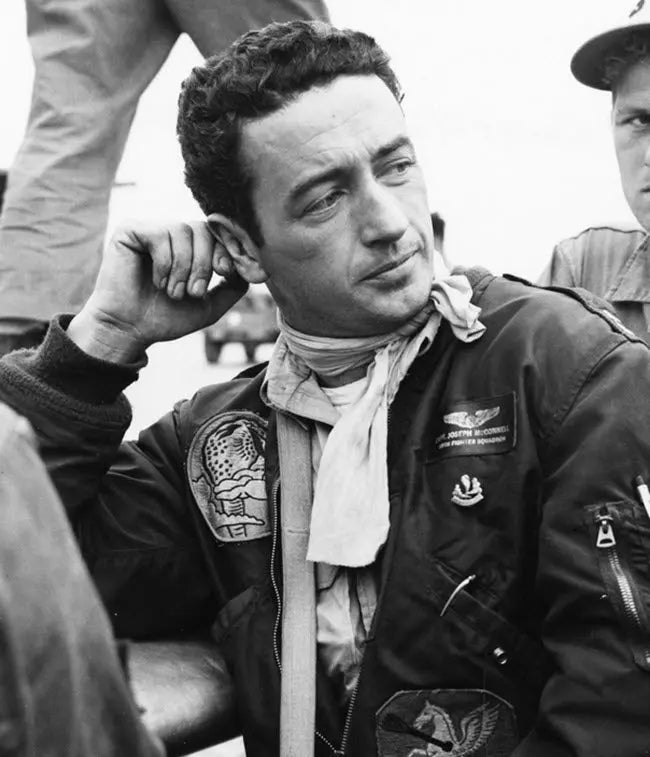
Maj. Frederick C. “Boots” Blesse in his F-86 during the Korean War. (U.S. Air Force photo) Note the stars on the side of his cockpit. Blesse flew 121 missions in his North American F-86 Sabre jet.

A Korean War North American F-86 Sabre jet on a parking pad being serviced.
North American F-86 Sabre jet specifications:
- Crew: 1,
- Length: 37 feet, 6 inches;
- Height: 14 feet, 8 inches;
- Wingspan: 37 feet, 1 inch;
- Maximum speed: 685 mph;
- Cruising speed: 540 mph;
- Range: 1,200 miles;
- Combat ceiling: 49,000 feet;
- Powerplant: One General Electric J47 turbojet with 5,200 pounds of thrust;
- Cost: $ 178,000 each
Maj. "Boots" Blesse possesed outstanding aerial combat skills, marksmanship, and tactical awareness combined with a rare quality: intelligent aggressiveness. As an example how this served him will, on Septmber 8, 1952 "Boots" accomplished a dougle kill. He had just downed one MiG-15 and turned towards home base when he was suddenly attacked by another enemy jet.
For the next five minutes Blesse was forced to use all of his skills in a fight for his life. After a number of loops, rolls, and high-G turns, he turned the table on the MiG-15 and was able to get into a position from which he delivered a lethal gun burst at a distance of 1,500 feet. This downing of two MiG-15s at the same time made Blesse the leading ace in Korea.
During his time in Korea Blesse was credited with destroying 10 enemy aircraft in aerial combat, plus one probable and three more damaged. During the Korean War Blesse received the Distinguished Service Cross. Frederick C. Blesse was one of the greatest aces of the Korean War era.
His citation reads as follows:
"For conspicuous gallantry in action against an armed enemy of the United Nations as a pilot, 4th Fighter-Interceptor Wing, Fifth Air Force, on 8 September 1952.
Leading a flight of four F-86s protecting fighter bombers from possible attack by enemy MIGs, Major Blesse positioned his flight for an attack on four sighted MIGs. Singling out one of the MIGs, Major Blesse followed it up into an overcast and broke out between layers of clouds. As the two aircraft emerged from the clouds, Major Blesse was still in position, so he closed and fired, causing the MIG to burst into flames and the pilot to eject himself.
Major Blesse then sighted a lone MIG, and positioned himself for another attack. The MIG began violent, evasive maneuvers, but through superior airmanship Major Blesse scored hits, causing the MIG to snap and spin. Major Blesse followed closely until the MIG recovered. He then scored hits with another long burst which caused the pilot to eject himself.
Through his courage, keen flying ability and devotion to duty, Major Blesse reflected great credit upon himself, the Far East Air Forces, and the United States Air Force."
After Major Blesse returned to the United States in October of 1952, he spent some time putting together a manul documenting the lessons he learned flying air-to-air combat. The manual, called "No Guts, No Glory," was written in 1955, and was used for over 25 years as the go-to authority on how to train for and fly in aerial combat.
The handbook gives a detailed explanation of the flying technique and cognitive process that a fighter pilot needs to survive and prevail in air-to-air combat. The book is composed of 3 sections: The Offensive, The Defensive, and Related Subjects. The Offensive Section provides information about the objectives of tactical information, high-altitude formation flying, combat tactics, and the basic principles of offense.
On the other hand, The Defensive Section provides learning on the defensive tactics, calling breaks, scissor maneuvers, minimum fuel returns, and the basic principles of defense.
Lastly, the Related Subjects Section provides information about the employment of fighters, selection of flight and element leaders in combat, speed brake utilization, guns and gun sights, and binoculars in combat. An opponent must be engaged in combat if a fighter is going to shoot him down. Mixing up, a term coined by Blesse, entails picking up on the activity on the radio, locating it via the controllers or other pilots involved, directing your flight there, and engaging in combat.
During most of his career Blesse continued on flying fighter aircraft, accumulating a total of more than 6,500 hours of flight time in fighter aircraft, and more than 650 hours of combat time during his career.
In 1955, during the USAF Air Force Worldwide Gunnery Championship, he flew the F-86F as a member of the Air Training Command team. He won all six trophies offered for individual performance. This is a feat has never been equaled since.
In 1967 Blesse once agin volunteered for combat duty, and was assigned as the Director of Operations, 366th Tactical Fighter Wind, Da Nang Air Base, Vietnam. In that role Blesse flew 108 combat missions over North Vietnam, and another 46 sorties in Laos and South Vietnam in the McDonnell Douglas F-4 Phantom II.,

A McDonnell Douglas F-4 Phantom II in flight over Vietnam.
McDonnell Douglas F-4 Phantom II specifications:
- Crew: 2;
- Length: 62 feet, 11.91 inches;
- Height: 16 feet, 5.64 inches'
- Wingspan: 38 feet, 7.39 inches;
- Powerplants: 2 each General Electic J79-GE-17A turbojets productin 2 x 11,870 pounds of thrust;
- Top speed: 1,473 mph;
- Cruise speed: 552 mph;
- Approach speed: 288 mph;
- Landing speed: 201 mph;
- Maximum takeoff weight: 61, 795 pounds;
- Maximum payload: 18,739 pounds;
- Fuel capacity: 1,994 gallons;
- Combat range: 370 miles;
- Ceiling: 60,000 feet.
Blesee was instrumental in the development and testing of the SUU-16 chin gun pod, used throughout the war, and was amajor factor in the decision to include an internal gun in later versions of the F-4 Phantom. He then commanded the USAF's first wing of General Dynamics F-111 Aardvarks, and then returned to Vietnam as Assistant Director of Operations for the Seventh Air Force.
Frederick Corbin "Boots" Blesse retired as a Major General of the US Air Force in 1975, followed by working for the Grumman Corporation. He went on to retire with his wife Betty in Florida.
On October 31, 2012, "Boots" Blesse passed away at the age of 91 in Melbourne, Florida. "Boots" was survived by his wife, Betty, and his children Kent Blesse, Melanie Blesse Fileppo, Angelie Blesse, and Chris Blesse. He was also survived by his stp-children, Bill Lunch, Eileen Husselbaugh, and Dan Lyych; his brother Jim Blesse, and sister Joan Griffin.
"Boots" Blesse was laid to rest in Arlington National Cemetary.

An Air Force legend was laid to rest in Arlington National Cemetery March 22, officially "flying west."

A flight of F-15E Strike Eagles from Seymour Johnson Air Force Base, N.C., perform a flyover for retired Maj. Gen Frederick "Boots" Blesse's funeral, March 22, 2013, at Arlington National Cemetery.
I hope you enjoyed this trip through some of the history of aviation. If you enjoyed this trip, and if you are new to this blog, sign up to receive your own weekly blog post here: Subscribe here!
Until next time, keep your eyes safe and focused on what's ahead of you, Hersch!




Written by John M. White

Search this site
Recent Posts
-
The Perfect Gift Ideas for Pilots: From Sunglasses to Aircraft Models
October 03, 2026 -
Why Are Aircraft Wood Models Popular Among Collectors?
October 03, 2026 -
Jimmie Angel, Aviator, Explorer, Prospector
September 19, 2026 -
Imagine Finding Yourself In A Freefall from 28,000 Feet!
July 31, 2026
Leave a comment
This site is protected by hCaptcha and the hCaptcha Privacy Policy and Terms of Service apply.