
An Unselfish Act
Heroism comes in many different forms, and as youg boys we all grow up and think that we would be willing to give up our life so another might live. But as we get older, life becomes more real, especially for those young men who decide to join a branch of the military and serve our country.
What follows is the story of one such young man who, when faced with exactly that choice, selflessly did what was necessary to save the life of another.
On April 22, 1946, a baby boy by the name of Steven Logan Bennett arrived at his new home in Palestine, Texas, to the delight of his mother Eidith and father Elwin. Steven joined his five younger siblings in the family.
Soon the family departed Palestine, Texas for a new home in Lafayette, Louisiana. Young Steven grew up like so many young men, and in 1960 entered Youngsville High School where he studied and played a game he loved: football!
Following high school Steven enrolled at Soutwestern Louisiana State University in Lafayette, Louisiana, where he majored in Aeronautical Engineering and joined the AFROTC (Air Force Reserve Officer Training Corps) program at the university.
The Arnold Air Society
In 1947, the Arnold Air Society was proposed as an extracurricular activity for AFROTC cadets at the University of Cincinnati. Thier idea was approved by active duty members of the USAF, after which the cadets followed with a constitution for the new, honorary society.
It was called the "Arnold Society of Air Cadets" in honor of 5-Star General of the USAF named Henry "Hap" Arnold. The first Honorary Sponsor was Ms. Elanor Arnold, and General James Doolittle was chosen to be the Honorary Commander following General Arnold's death in 1950.

The emblem of the Arnold Air Society.
The Society was offically recognized by the USAF in April of 1948, and by 1955 it consisted of 185 squadrons across the United States. Each member must belong to a local AFROTC detachment and meet thos academic and physical standards.
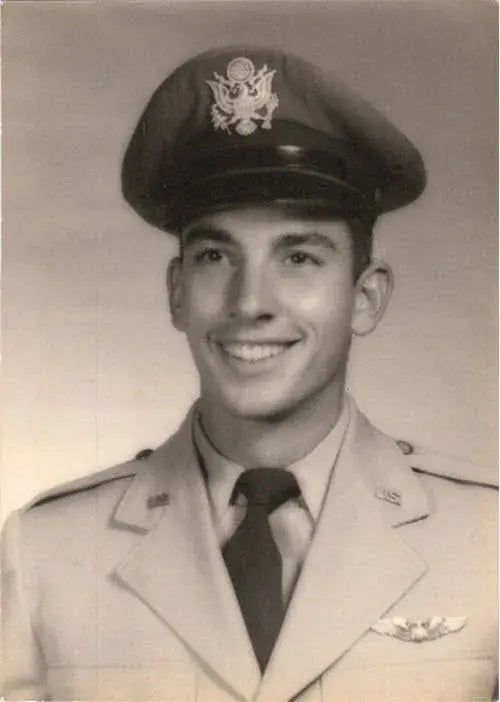
While at university Bennett joined the Arnold Air Society and became the Commander of the Arnold Air Society. While at the university he earned his Private Pilots license in 1965. Upon graduation from Soutwestern Louisiana State, Steven L. Bennett was commissioned as a 2nd Lt. on August 12, 1968.
Bennett Joins The USAF
Shortly after he was commissioned as a 2nd Lt. Bennett married his sweetheart, Linda Leveque, and the went on to have a daughter with her that they named Angela Bennett.
In 1968, he began his active duty in the Air Force and earned his Air Force pilots wings while at Fairchild Air Force Base in the state of Washington. From there, Lt. Bennett was sent to Castle Air Force Base in California where he completed combat crew training in the B-52 Stratofortress.
He then flew combat missions as a B-52 pilot while on TDY (Temporary Duty) in Thailand from September to December in 1970. Following that, in 1972, now Captain Bennett completed upgrade training in the North American Rockwell OV-10 Bronco Light Attack aircraft, he would serve as a FAC (Forward Air Controller) with the 20th Tactical Air Support Squadron based at Da Nang Air Base in South Vietnam.

A pair of OV-10 Bronco light attack and observation aircraft.
Specifications for the OV-10 Bronco
- Crew: 2;
- Length: 41 feet 7 inches;
- Wingspan: 40 feet;
- Height: 15 feet 2 inches;
- Empty weight: 6,969 pounds;
- Loaded: 9,908 pounds;
- Max takeoff weight: 14,466 pounds;
- Powerplant: 2 each Garrett-AiResearch T76-G-412 turboprop engines with 715 shaft horsepower each;
- Maximum speed: 281 mph;
- Range with maximum weapons: 228 miles;
- Ferry range: 1,428 miles.

North American Rockwell OV-10 Bronco firing rockets at a target, southwest of Da Nang, 1970.
Vietnam, June 29, 1972
On June 29, 1972, Capt. Bennet flew his OV-10 Bronco on a mission to provide close air support for strikes by Navy fighters at a heavily defended area near Quang Tri City in South Vietnam. In the rear seat was Marine Capt. Michael B. Brown, an airborne artillery observer.
Capt. Brown was directing gunfire from two US Navy destroyers offshore in the Gulf of Tonkin in support of friendly forces in Vietnam. After about three hours, they were ready to return to their Da Nang Air Base when Capt. Bennett recevied a call for help.
It was from a small group of about 50 South Vietnamese soldiers who were very close to being run over by a much larger North Vietnamese force. They desperately needed air support to cover their escape.
By this time there was no friendly firepower in the area. Bennet was advised that there was no tactical air support in the area, and the gunfire from the destroyers would probably endanger the trapped South Vietnamese troops.
Their only chance was Bennett, if he would intervene. But to do so was dangerous, because there were large numbers of 23mm and 37mm antiaircraft guns used by the enemy, along with the risk of the heat-seeking SA-7 Grail surface to air missiles (SAMs).

The SA-7 Grail, developed by the Soviet Union in the 1960s, is a man-portable air defense systems (MANPADS).
These heat-seeking missiles were 4.72 feet long, had a range of 0.5 to 2.6 miles, a ceiling of 7.546 feet, and flew at Mach 1.5 towards their target. The reason these SA-7s were so feared by pilots like Bennett is that the OV-10 Bronco's engines produce a lot of heat. This is the reason they like to always fly above 9,500 feet on their missions.
26 year old Capt Bennett understood the risks, and that to help the men on the ground would put himself, Capt. Brown, and the aircraft in great danger. The area they were operating in was known as "SAM-7 Alley," an area with a lot of SAMs available.
However, Bennett didn't hesitate to help, and began attacking enemy positions with his aircraft's small machine guns. After four passes, the enemy began to retreat, but on the next, and fifth pass, a SAM-7 slammed into the left side of the aircraft, hitting the left engine and left main landing gear.
Quickly Bennett realized that a fire was quickly spreading throughout the aircraft. Immediately Bennett understood they would likely not be able to make it to a friendly airfield, so he told Capt. Brown to eject from the plane.
As they prepared Capt. Brown noticed that his parachute had been shredded by the SAM-7, and that there was no way he could escape the aircraft. Thinking quickly, Bennett decided to head for the Gulf of Tonkin and ditch the airplane in the water.
Bennett had chosen the most selfless thing anyone could have done - ditch his aircraft in the Gulf, fully knowing that no pilot in this aircraft type had ever survived a controlled emergency water landing before, So, Bennett knew his chance of survival was slim, but he was determined to save Capt. Brown.
As the aircraft struck the water it cartwheeled over and smashed the pilot's windscreen into small pieces. Brown struggled to get out, but he finally reached the surface. He tried numerous times to try and save Bennett, but the plane began to sink before he could make any headway in saving Capt. Bennett.
There were five or 10 minutes before we would hit the water, and [Bennett] knew full well his chances were virtually nil," Brown told The Daily Advertiser newspaper out of Lafayette in 2010. "He could have gotten out himself, but he chose not to do that."
Bennett was in the country for less than three months when he gave his life to save another.
Brown, who was rescued soon after, knew Bennett had given his life to save him. Bennett's body was recovered from the gulf the next day. He was returned home and buried in Lafayette Memorial Park Cemetery and Mausoleum in his hometown.
The Medal of Honor

Captain Steven L. Bennett, United States Air Force. (U.S. Air Force 090617-F-1234P-040)
Citation
Capt. Bennett was the pilot of a light aircraft flying an artillery adjustment mission along a heavily defended segment of route structure. A large concentration of enemy troups were massing for an attack on a friendly unit. Capt. Bennett requested tactical air support but was advised that none was available. He also requested artillery support, but this too was denied due to the close proximity of friendly troops to the target. Capt. Bennett was determined to aid the endangered unit and elected to strafe the hostile positions. After four such passes, the enemy forces began to retreat. Capt. Bennett continued the attack, but, as he completed his fifth strafing pass, his aircraft was struck by a surface-to-air missile which severely damaged the left engine and the left main landing gear. As fire spread in the left engine, Capt. Bennett realized that recovery at a friendly airfield was impossible. He instructed his observer to prepare for ejection, but was informed by the observer that his parachute had been shredded by the force of the impacting missile. Although Capt. Bennett had a good parachute, he knew that if he ejected, the observer would have no chance of survival. With complete disregard for his own life, Capt. Bennett elected to ditch the aircraft into the Gulf of Tonkin, even though he realized that a pilot of this type aircraft had never survived a ditching. The ensuing impact upon the water caused the aircraft to cartwheel and severely damage the front cockpit, making escape for Capt. Bennett impossible. The observer successfully made his way out of the aircraft and was rescued. Capt. Bennett's unparalleled concern for his companion, extraordinary heroism, and intrepidity above and beyond the call of duty, at the cost of his life, were in keeping with the highest traditions of the military service and reflect great credit upon himself and the U.S. Air Force.
On August 8, 1974, Bennett's widow and young daughter received the Medal of Honor on his behalf from Vice President Gerald R. Ford.
Brown, who met Angela Bennett when she got older, became close with the daughter of the man who saved his life.
"I've never met a braver man than Steve," Brown said during his 2010 interview.
Bennett's sacrifice has been remembered across the Defense Department. In 1997, the Military Sealift Command acquired a container ship and renamed it the Capt. Steven L. Bennett. Buildings at other military installations are also named for the pilot.

The Sealift Incorporated container ship, MV Capt. Steven L. Bennett (T-AK-4296), was named in his honor.
In his hometown of Lafayette, the Cajundome Convention Center dedicated a memorial plaza to Bennett in 1985.
I hope you enjoyed this trip through some of the history of aviation. If you enjoyed this trip, and if you are new to this newsletter, sign up to receive your own weekly newsletter here: Subscribe here!
Until next time, keep your eyes safe and focused on what's ahead of you, Hersch!




Written by John M. White


Search this site
Recent Posts
-
The Perfect Gift Ideas for Pilots: From Sunglasses to Aircraft Models
October 03, 2026 -
Why Are Aircraft Wood Models Popular Among Collectors?
October 03, 2026 -
Jimmie Angel, Aviator, Explorer, Prospector
September 19, 2026 -
Imagine Finding Yourself In A Freefall from 28,000 Feet!
July 31, 2026

Leave a comment
This site is protected by hCaptcha and the hCaptcha Privacy Policy and Terms of Service apply.