
Black Sheep Aces
On September 16, 1940, just prior to the entrance of the United States into World War II, the United States Congress passed the Selective Training and Service Act of 1940. This was the first peacetime conscription of able bodied men between the ages of 21 and 45, and required them to register for military service. This act was commonly referred to as the Draft.
It was clear to many young men that they were not going to evade conscription if the United States decided to enter the war in Europe. In fact, many young men decided not to wait to be drafted, but rather to enlist in the branch of service they wanted to serve in as opposed to being drafted and sent to serve in a job they really did not want.
One such group of young men, of the Case family from Portland, Multnomah County, Oregon, had three brothers who did volunteer to serve during World War II. The brothers were Jeff Case, the oldest brother, William Northrop Case, the middle brother, and Relf Case, the youngest brother. All three of them joined the Navy, volunteering to serve in World War II.
Jeff Case became a Lt. Jg in the navy, serving as a flier serving on Atlantic patrol duty, while William "Billy" Case joined the United States Marine Corps and served as a fighter pilot, and Relf, who was enrolled at the Univeristy of Idaho, signed up to serve in the navy V-12 program.
The Navy College Training Program (V-12) put men on active duty as apprentice seamen, drawing pay as such. The government paid their room and board, and the officer cadidates were not subject to conscription as long as they retained their enlisted ranking and kept up with their school work.
Our focus today will be on William "Billl" Northrop Case. Bill Case was born on November 18, 1920, in Portland, Oregon. He was the middle child between the brothers, and there is little more that I can find out about his early life. But, over time, Bill received training to become an officer in the U.S. Navy, and was assigned as a fighter pilot in the United States Marine Corps. Eventually, he became one of the pilots in the famous (or infamous) Black Sheep Squadron VMF-214 led by Major "Pappy" Boyington.

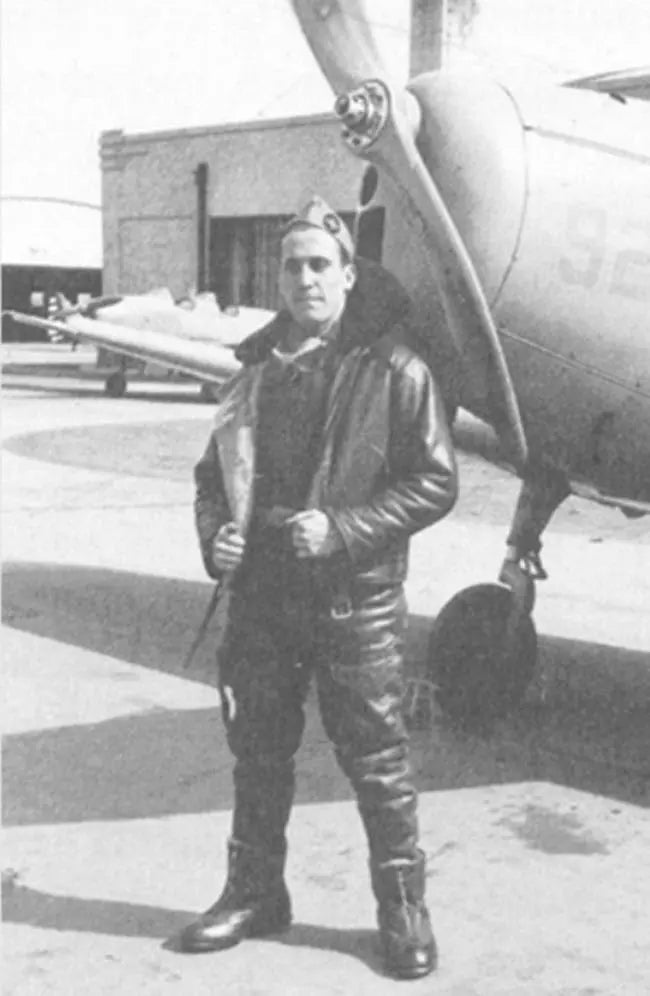
This is a photograph of newly commissioned William N. Case, United States Marine Corp fighter pilot with his shiny new wings.
Becoming a Marine Corps aviator was not for the faint of heart. One of the things they had to do during their flight training was to jump from a platform into a pool filled with debris to simulate what bailing out of an aircraft into a battle zone might be like:

USMC VMF-214, The Black Sheep Squadron
On July 1, 1942, Marine Fighter Squadron Two Hundred Fourteen (VMF-214) was formed iat Ewa Field, Oahu, Hawaii. Initially the squadron was given the nickname of "Swashbucklers", but that changed when Major Gregory Boyington, a highly decorated officer, was placed in command of the squadron in August of 1943.
Boyington had joined the Marine Corps on June 13, 1935, and applied for flight training under the Aviation Cadet Act. But, as it turned out, Boyington was not accepted because of a mixup in his family's records. Records at that time showed that he was married, and so he was disqualified for the training. Boyington, not to be deterred, obtained a copy of his birth certificate, discovered his father was actually Charles Boyington, and that his parents were divorced while he was an infant.
As there was no record of Gregory Boyington ever being married, that resolved the "married" issue, and he was finally accepted as a U.S. Marine Corps aviation cadet using that name. On March 11, 1937, he won his wings and a commission as a 2nd Lt in the U.S. Marine Corps as a naval aviator.
When World War II began, a civilian firm was contracted to recruit pilots to staff a Special Air Unit organized to defend China and the Burma Road. Boyington, ever anxious to get into the fight, quickly resigned his commission in the Marines, and joined the group. The group later became known as the American Volunteer Group, also known as the famous Flying Tigers, in Burma. During his time with the Tigers, Boyington became a flight leader.

A painting of a pilot flyind a Curtiss P-40 Warhawk on patrol in WW II.
However, Boyington frequently found himself in trouble with the commander of the Flying Tigers, Claire Chennault, and was reportedly disliked and not trusted by the other pilots in the goup. As a result, in April of 1942, he broke his contract with the American Volunteer Group and headed for home. On Septmber 29, 1942, he rejoined the Marine Corps as a Major.
His first assignment was with Marine Aircraft Group 11 as executive officer of Marine Fighter Squadron 122 (VMF-122) operating out of Guadalcanal. During this time period Boyington honed his flying skills becoming an aggressive and highly skilled pilot. While there he never got the chance to shoot down an enemy aircraft, and from July to August of 1943 wound up in command of the squadron.
In September of 1943 he became the commanding officer of Marine Fighter Squadron 214 (VMF-214). When he took over the squadron his first task was to assemble a group of pilots. He wanted to find a group of pilots that could match his own fighting spirit. So, he scoured the pool of pilots who were available to be reassigned, some of which were considered misfits. It was here that Maj. Boyington found his pilots, and soon thereafter they became known as the Black Sheep Squadron because otheer pilots considered them trouble makers.
The fact is that these pilots were among the most experienced pilots in the Pacific theater. In truth, most of these pilots, including the rookies, had accumulated a high number of flight hours, and several of the vetrans had already accumulated aerial victories against the Japs.
As you may have already guessed by this time, one of those pilots was a young naval aviator by the name of William Northrop Case. The squadron quickly took up training in the Chance Vougt F4U Corsair. The Corsair was known for its speed and firepower, but its handling characteristics made it a difficult airplane to fly for inexperienced pilots.
The F4U Corsair Specifications:
- Crew: 1 pilot;
- Length: 28 feet 9 inches;
- Wingspan: 40 feet, 11 inches;
- Height: 14 feet 9 inches;
- Empty weight: 9,900 pounds;
- Gross weight: 1,4 079 pounds;
- Powerplant: 1 X 2,850 hp Pratt & Whitney Double Wasp radial engine
- Maximum speed: 331 mph +;
- Ceiling: 44,000 feet;
- Range: 1,000 miles;
- Armament: 6 x 0.50 calibre machine guns, 4 x 20mm cannons, 2,000 pounds of bombs.

A flight of Chance Vought F4U Corsairs over some islands in the Pacific.

A photograph of members of the newly re-formed VMF-214 pilots "scramble" for an intercept of the enemy.
In fact, this famous photograph was staged on Espiritu Santo, hundreds of miles from the Solomons, on September 11, 1943, before any of the Black Sheep had flown together in combat. In this photograph is Bill case, the pilot at the left, wearing Australian flight boots.

A photograph of Bill Case sitting in his Chance Vought F4U Corsair.
Bill Case had flown earlier with VMF-112, and had shot down a Zero over Kahili airfield located near Buin, Bouganville Island, Papua New Guinea. Like most of the experienced pilots who started out with Boyington's Black Sheep Squadron, he only served one tour.
At the young age of just 22, Bill Case was one of those pilots who had a sense of invincibility. He first recognized this when he engaged a Ki6 Tony head-on ignoring the orange and black gunfire coming right at him. Case never waivered while playing chicken with the Jap Pilot, who then pulled up at the last second.
On September 18, 1943, Case won his first victory as a Black Sheep when he flew in behind a Jap Zero that took no evasive moves at all, simply flying a long, sweeping turn into a cloud. Case moved up to within 50 feet of the Zero even though they were both in the clouds. Case opened fire only to see his bullets spread out and pass the Zero on either side. Quickly realizing his mistake, Case slid off to the side of the Zero which allowed three guns on one side of his aircraft to destroy the Zero.
On September 27th Case was flying wingman to Boynton on an escort mission and scored his third victory. However, it came at a cost as Case's aircraft was shot up by the enemies bullets puncturing his F4U's 25 gallon oil reservoir, forcing him to land, as his oil drained out, on Vella Lavella.
Within three hours the Seabees replaced his oil reservoir by scavenging one from a recently crashed Corsair. By the time Case returned to base he discovered his fellow pilots had already divvied up his belongings, assuming he was dead. He took one look, sauntered over to the mess hall, and had dinner. By the time he returned all of his stuff had been returned.
Sometimes victories came by luck. On October 11, 1943, Case spotted a Zero about a mile away and decided to test-fire his aircraft's guns. The Zero, unaware that Case had closed the distance to about 800 yards, simply flew the aircraft into the stream of bullets from Case and went down in flames. Three days later Case found himself in a dogfight and saw "something, possibley a drop tank," splash down in the water. Because Case was already three miles up when he saw the splash, everyone assumed it had to be something bigger, like an airplane, and so Case was credited with another kill.
On Case's last day in combat, on October 18, 1943, fortune smiled on Case. As Case was quite short, he always had his cockpit seat up as high as it would go. On this day he lowered it one notch, and while in battle a Zero's bullets smashed into his cockpit just grazing his head and leaving it bloody. Had he been any higher, he no doubt would have been killed.
By the time Case was done with the Black Sheep squadron he had accumulated 8 aerial victories, making him the third highest Ace in the VMF-214 Black Sheep Squadron.
But, Case survived and after completing his tour continued on his aviation career. He eventually flew in the Korean War, and by the time he finished his military career had been awarded the Distinguished Flying Cross five times, four in World War II and once in Korea.

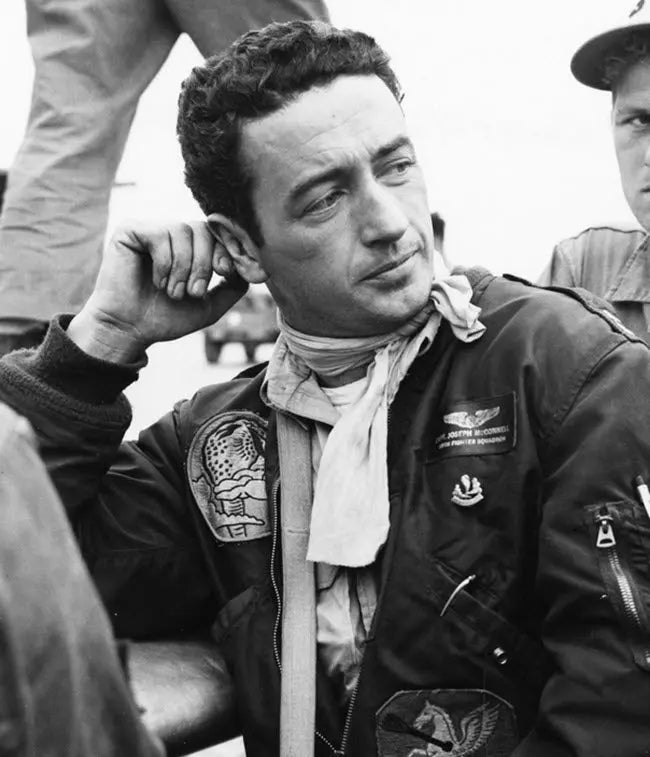
Captain William Nortrop Case in Korea.
On November 25, 1995, at the age of 75, William Northrop Case passed away in Seattle, King County, Washington state.
I hope you enjoyed this trip through some of the history of aviation. If you enjoyed this trip, and if you are new to this blog, sign up to receive your own weekly blog post here: Subscribe here!
Until next time, keep your eyes safe and focused on what's ahead of you, Hersch!




Written by John M. White


Search this site
Recent Posts
-
The Perfect Gift Ideas for Pilots: From Sunglasses to Aircraft Models
October 03, 2026 -
Why Are Aircraft Wood Models Popular Among Collectors?
October 03, 2026 -
Jimmie Angel, Aviator, Explorer, Prospector
September 19, 2026 -
Imagine Finding Yourself In A Freefall from 28,000 Feet!
July 31, 2026

Leave a comment
This site is protected by hCaptcha and the hCaptcha Privacy Policy and Terms of Service apply.