
Lt. Stanley W. Vejtasa, USN
On a warm day on July 27, 1914, in Paris, Montana, where a young boy arrived as the firstborn in the Czecg-Norwegian family of John and Inga Amalia Vejtasa on July 27th, 1914. They named the young boy Stanley W. Vejtasa, and as he grew up the family grew. He was followed by his sister Mildred, then his brother John, then Frank, and finally his brother Eugene.
After grade and high school, young Stanley attended Montana State College, and later he transferred to the University of Montana. At the age of 23 Stanley decided to enlist in the U.S. Naval Reserve program on September 15, 1937, and on July 20, 1938 Stanley was appointed as a Naval Aviation Cadet. After completion of flight school, young Vejtasa was commissioned as an Ensign on August 11, 1939, and was awarded his U.S. Navy Wings of Gold.
Vejtasa was then sent for training in the Douglas SBD-3 Dauntless dive bomber, including carrier takeoffs and landings. His first assignment after training was with Scouting Squadron FIVE (VS-5) aboard the aircraft carrier USS Yorktown (CV-5), from August of 1939 to May of 1942.

The USS Yorktown (CV-5) conducts aircraft operations in the Pacific sometime before the battle of the Coral Sea.

A Douglass SB3 Dauntless dive bomber in flight over the Pacific Ocean.
Specifications:
- Crew: 2 (pilot and gunner;
- Length: 33 feet 1 inch;
- Wingspan: 41 feet 6 inches;
- Height: 13 feet 11 inches;
- Engine: 1 x Wright R-1820-60 Cyclone generating 1,200 horsepower;
- Empty weight: 8,050 pounds;
- Max takeoff weight: 10,700 pounds;
- Cruise speed: 255 mph;
- Range: 1,570 miles;
- Service ceiling: 25,530 feet;
- Armament: 2 x .50 caliber and 2 x .30 caliber machine guns;
- Bomb load: 1,000 pounds.
After the attack on Pearl Harbor, Hawaii, Japanese senior military leaders began looking at future operations. As they looked at their perimeters, they realized that their southern perimeter was their most vulnerable, and they were aware that while Great Britain was occupied with Germany, that the Ausies would ask the United States for help. Japan felt that if they could cut off Australia it would, at the same time, make the Allies worried.
The British had been crushed in Hong Kong, Malaya, and Borneo, ending in humulilation when they surrendered Singapore in February of 1942. They had lost the vital port of Rabaul at the tip of New Britain, and this gave the Japanese a critical base near the Solomon Islands and New Guinea. To make things worse, the Dutch had lost their vital oil fields in Sumatra and Java to the Japanese.
The Allies now found themselves in the uncomfortable postion of the Japanese holding the initiative, and now both India and Australia seemed to be under the threat of invasion. This created tremendous anxiety for the United States because Australia figured prominently in their plans to retake the Indies. The Japanese were now moving down the line of the Solomon Islands towards Fiji, Tonga, and Samoa, cutting off supply lines to America.
The picture looked bleak for the Americans. The Japanese were almost at the doorstep to Australia, so the Prime MInister of Australia knew their would be no help coming from Britain, so he turned to President Roosevelt for assistance. Roosevelt had assured Australia that the US would do whatever it took to protect this vital ally.
By May, British resistance in Burma collapsed, and they were being forced back to the Indian frontier. Meanwhile, Bataan in the Philippines had fallen in April, and some 75,000 American and Filipino troops were captured by the Japanese. On May 6th, Corregidor had fallen as well. For the Allies, all of this was an outright calamity. In early May 1942, Imperial Japan was threatening to isolate Australia from American support by invading New Guinea.
The Battle of the Coral Sea
While serving on the USS Yorktown, Lt Stan 'Swede' Vejtasa participated in the Battle of the Coral Sea from the USS Yorktown, flying the Doulgas SBD-3 Dauntless, a dive bomber. The battle lasted from May 4 to May 8, 1942, and during that time Lt. Vejtasa shot down 3 enemy Japanese Zero fighters and damaging another.
In addition, Lt. Vejtasa helped sink the Japanese aircraft carrier "Shoho" during the battle. It should be noted that the Douglas SBD-3 Dauntless dive bomber was considerably less maneuverable than the Japanese Zero, making his aerial victories even more stunning.
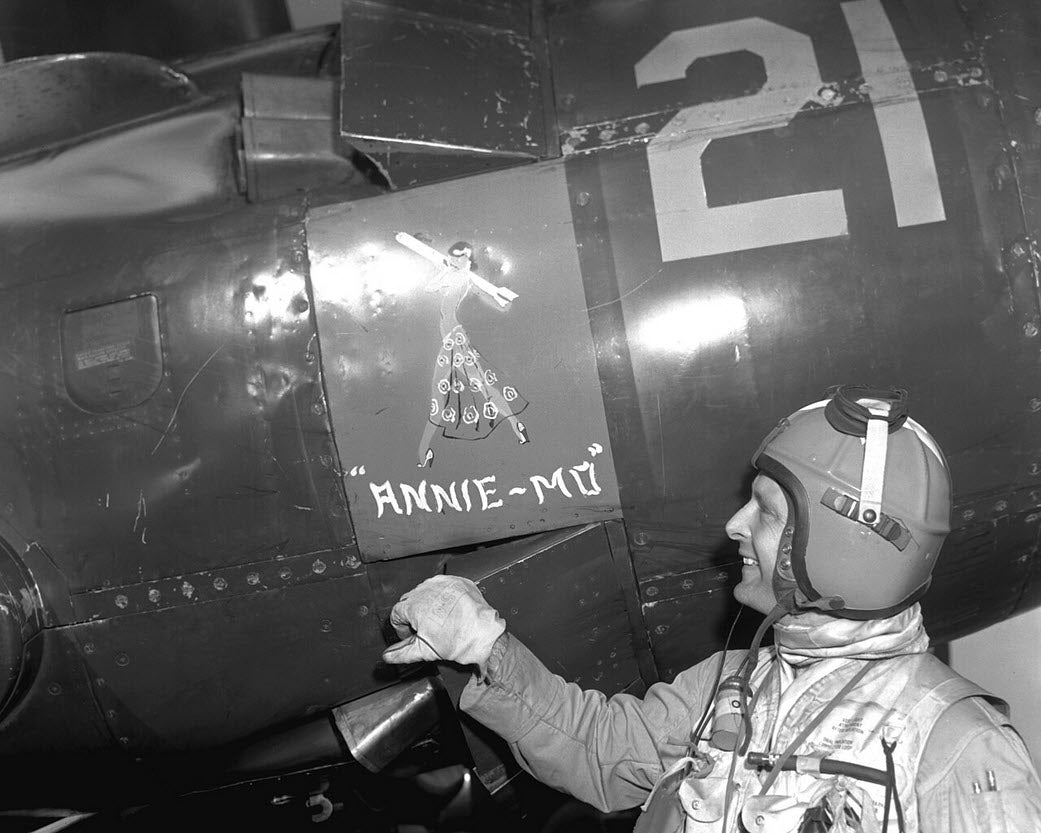
His next assignment was with VF-10, "The Grim Reapers" squadron, aboared the USS Enterprise. During this tour Lt. Vejtasa flew the Grumman F4F Wildcat off the carrier USS Enterprise in the Battle of Santa Cruz Islands on October 26, 1942. During this battle, the USS Enterpirse was hit twice and suffered three damaging near misses.

A Grumman F4F Wildcat of the VF-10 Grim Reapers launches from the carrier Enterprise 10-26-1942.
Specifications:
- Crew: 1 pilot
- Length: 28 feet 9 inches;
- Wingspan: 38 feet;
- Height: 11 feet 10 inches;
- Engine: 1 x Pratt & Whitney R-1830-76 generating 1,200 horsepower;
- Cruise speed: 331 mph;
- Range: 1,270 miles;
- Service ceiling: 39,500 feet;
- Max takeoff weight: 8,750 pounds;
- Max payload: 1,100 pounds;
- Armament: 6 x .50 caliber M2 Browning Machine Guns.
The Battle of the Santa Cruz Islands
During this battle, Lt. Vejtasa was flying the Grumman F4F Wildcat, and he shot down two Japanese Aichi D3A Type 99Val dive bombers attacking the already crippled USS Hornet (CV 8). Later that same day, the 28 year old Montana native splashed five B5N2 Kate torpedo bombers as they honed in on his own carrier, the USS Enterprise (CV 6).
As he began running out of amunition, he managed to set a sixth Japanese Kate on fire, earning yet another kill. The Japanese pilot, airplane on fire, dove his Kate into the American destroyer USS Smith (DD 378), which absorbed the fiery crash and subsequent torpedo explosion.
VF-10's skipper, Lt. Dcr. Jimmy Flatley, considered Vejtasa's actions in eliminating at least six Japanese torpedo bombers as crucial to the Big E's very survival. With the USS Hornet mortally damaged and sunk the next morning, the beat up USS Enterprise remained the sole operational U.S. aircraft carrier left to defend Guadalcanal and the strategic Henderson field.
After this Vejtasa was promoted to Lt. Cdr and continued to serve in various posts, including attending the General Line School at Newport, RI from May of 1946 to May of 1947. On Jluy 1, 1970, after a distinguished 32-year career that included notable heroism as a decorated naval double ace during World War II.
Stanley W. "Swede" Vejtasa was the only World War II carrier pilot to receive two Navy Crosses; one each for dive bombing and aerial fighter combat. He passed away on January 23, 2013, at the age of 98.
I hope you enjoyed this trip through some of the history of aviation. If you enjoyed story, please share it with all of your friends. And, if you are new to this blog, sign up to receive your own weekly blog post here: Subscribe here!
Until next time, keep your eyes safe and focused on what's ahead of you, Hersch!




Written by John M. White


Search this site
Recent Posts
-
Jimmie Angel, Aviator, Explorer, Prospector
September 19, 2026 -
Imagine Finding Yourself In A Freefall from 28,000 Feet!
July 31, 2026 -
The "Flying Laughters"
July 24, 2026 -
The Born Dynasty
July 10, 2026

Leave a comment
This site is protected by hCaptcha and the hCaptcha Privacy Policy and Terms of Service apply.