
Guide to FAA Eyewear Regulations for Pilots
A pair of sunglasses can make a bright ramp more manageable. The wrong pair can make an instrument display harder to read, create distracting reflections, or leave you noncompliant with a medical certificate limitation. This guide to FAA eyewear regulations separates actual FAA requirements from practical cockpit guidance, so you can choose eyewear that supports safe, comfortable flying.
What the FAA Actually Regulates
The FAA does not publish a list of approved sunglasses brands, lens colors, or frame styles for pilots. You do not need "FAA-approved" sunglasses to fly. That phrase is often used loosely in marketing, but it is not a formal product certification pilots should rely on.
What the FAA does regulate is your visual fitness to exercise pilot privileges. For most pilots, the key issues are the vision standards associated with the appropriate medical certificate and any limitations placed on that certificate by the Aviation Medical Examiner, or AME.
Under 14 CFR 61.3, a pilot who is required to wear corrective lenses to meet the vision standard must wear them while exercising pilot privileges. If your medical certificate says "must wear corrective lenses," that is an operating limitation, not a suggestion. Flying with your prescription glasses in a flight bag instead of on your face does not satisfy it.
The practical question is simple: can you see clearly enough at the required distances, under actual cockpit conditions, while complying with the limitation printed on your certificate? For many pilots, that means prescription glasses, prescription sunglasses, contacts, or a combination of contact lenses and non-prescription sunglasses.
Medical Certificate Vision Standards and Limitations
FAA medical standards vary by certificate class and are evaluated during your medical examination. The AME evaluates distant and near vision, with intermediate vision also relevant for many pilots, especially those using glass cockpits, tablets, and panel-mounted avionics.
A limitation may read "must wear corrective lenses" or include language requiring the pilot to have corrective lenses available for near vision. Read your certificate exactly as issued. A pilot who needs correction for distance may need it full-time; a pilot who needs reading correction may need it for charts, checklists, an EFB, or avionics displays.
This is where one-size-fits-all eyewear gets pilots into trouble. A prescription that is excellent for driving may not be ideal for a cockpit. Your eyes shift among distant traffic, the panel, the center display, charts, and a tablet mounted at an intermediate distance. If your current lenses force you to tilt your head, peer over the top of the frame, or constantly refocus, discuss aviation use with your eye-care professional.
Bifocals, trifocals, progressives, and occupational lenses can all work well, but the best choice depends on aircraft type, panel layout, and your visual needs. Progressives offer a cleaner appearance and broad correction, yet some pilots prefer a defined near segment because it gives a predictable viewing zone. There is no universal winner. The right answer is the lens design that lets you read the panel and scan outside without fighting the optics.
Contacts and backup eyewear
Contact lenses are generally compatible with FAA medical certification when they provide the required vision. Still, pilots who wear contacts should carry a usable backup pair of glasses. Cabin dryness, long duty days, smoke, dust, allergies, and an unexpected lens problem can turn comfortable contacts into a distraction.
If you fly with contacts and depend on reading correction, make sure your backup plan covers both distance and near tasks. A pair of standard sunglasses may protect against glare, but it will not replace the corrective vision your certificate requires.
Sunglasses: FAA Guidance Versus Regulation
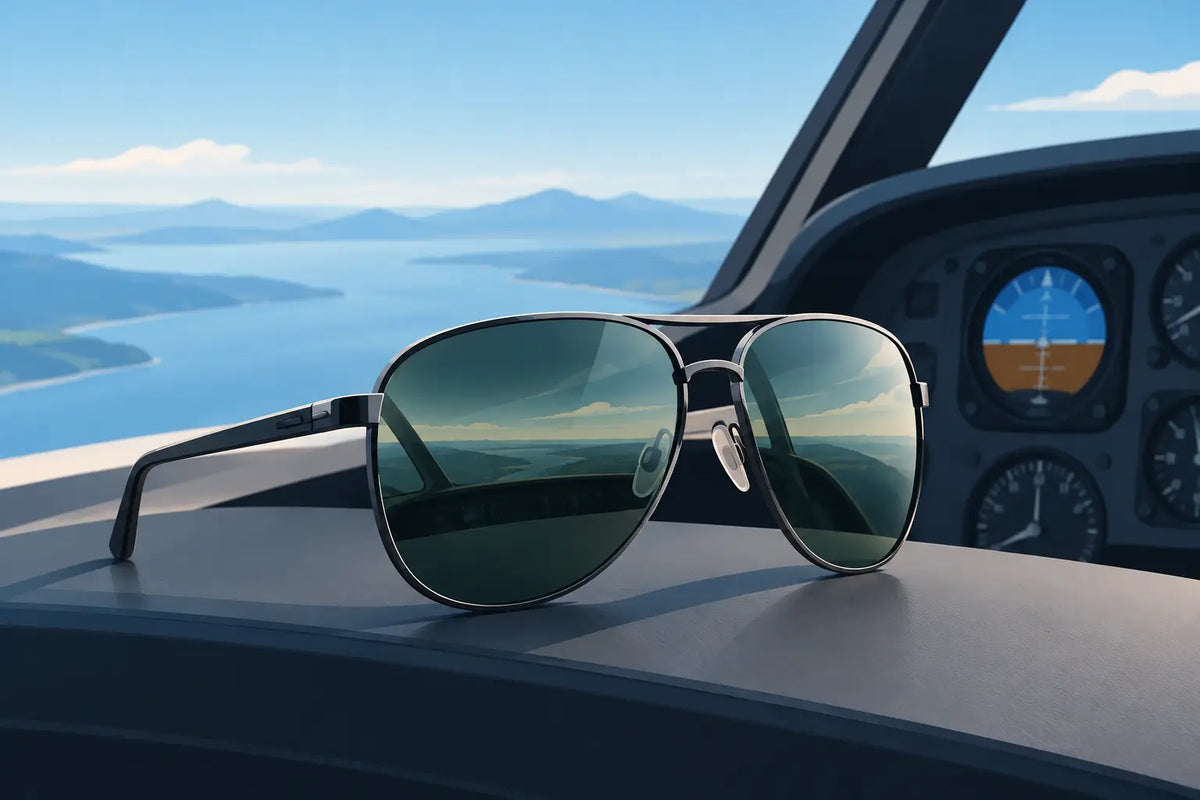
The FAA does not broadly prohibit pilots from wearing sunglasses. In fact, quality sunglasses are often a practical part of cockpit eye protection. They reduce discomfort in intense daylight, manage glare off clouds and water, and help preserve useful outside visibility on long flights.
However, common FAA safety guidance advises pilots to avoid polarized lenses in the cockpit. This is guidance based on operational risk, not a blanket federal rule that makes polarized sunglasses illegal for all pilots. The distinction matters, but so does the reason behind the recommendation.
Polarized lenses can interfere with the visibility of some LCD displays, electronic flight bags, and instrument screens. Depending on screen orientation and head position, the display may appear dim, distorted, or nearly black. Polarization can also make stress patterns in aircraft transparencies more noticeable and can affect how pilots perceive reflections, haze, wet surfaces, or ice.
For fishing, polarized lenses can be outstanding because they cut reflected glare from water. For aviation, that same feature can carry trade-offs that most pilots do not need. A high-quality non-polarized lens is generally the safer all-around cockpit choice.
Lens color matters more than fashion
Gray and neutral gray lenses are popular with pilots because they reduce brightness while preserving natural color perception. That makes them a strong choice for general daytime flying and for pilots who want consistent performance in varied light.
Brown, copper, and rose-based tints can increase perceived contrast, which some pilots appreciate in hazy conditions or against changing terrain. The trade-off is color shift. That does not automatically make them unsuitable, but pilots who rely heavily on accurate color recognition may prefer neutral gray.
Avoid overly dark lenses for flying. A lens that feels comfortable in direct sunlight may make shaded panels, unlighted cockpits, or changing weather harder to manage. Tinted eyewear is also not appropriate for night flying. If a flight may extend into dusk or darkness, have clear prescription eyewear available and use it before low light becomes a problem.
Choosing Frames That Work Under a Headset
FAA eyewear regulations focus on vision, but operational comfort matters because discomfort becomes distraction. Thick temples can create pressure points under a headset, break the ear seal, and increase fatigue during a long leg. A frame that fits perfectly on the ramp may become intolerable after two hours under active noise reduction clamps.
Pilots should look for thin, low-profile temples, a stable bridge fit, and frames that do not slide when looking down at a chart or tablet. Lightweight construction helps, but durability matters too. Frames are routinely handled with gloves, stored in flight bags, exposed to heat, and used in environments where replacement is inconvenient.
Lens quality deserves the same attention. Distortion near the edges can interfere with a visual scan, particularly in wrap-style frames. Good optical clarity, full UV protection, and a lens shape that gives useful side coverage are practical priorities. A large lens can offer excellent coverage, but it must fit your face without touching your cheeks or interfering with a headset.
For prescription pilots, consider keeping two cockpit-ready pairs: a clear pair for night, low light, and backup use, plus non-polarized prescription sunglasses for daytime operations. That is not an FAA requirement, but it is a sensible operational setup.
A Preflight Check for Your Eyewear
Before relying on a new pair of glasses or sunglasses in flight, test them on the ground. Sit in the aircraft, wear your normal headset, and look at every display you use. Check the primary flight display, engine instruments, navigation screen, tablet, backup instruments, and any mounted GPS. Move your head naturally rather than testing only from a perfect straight-ahead position.
Confirm that the frame does not compromise headset comfort or seal. Look outside at distant objects and then shift to the panel. If you wear progressive lenses, make sure the usable zones match your normal scan pattern. Finally, check the lenses for scratches, coating damage, and smudges. A small scratch that is irrelevant on a sidewalk can become a bright, distracting flare when the sun is low ahead of the aircraft.
This test is especially worthwhile after changing aircraft, avionics, prescriptions, or headsets. What worked in a steam-gauge trainer may not be ideal in a glass-cockpit turboprop or a corporate cabin environment.
When to Ask for Expert Help
Your AME is the right resource for questions about medical certification standards and the wording of your limitation. Your optometrist or ophthalmologist can help with prescription design, eye health, and lens recommendations. For fit and cockpit-specific frame selection, advice from someone who understands headset use can prevent expensive trial and error.
At Aviator Sunglasses, that conversation is grounded in real cockpit experience, not a generic fashion quiz. The goal is not to sell the darkest lens or the trendiest frame. It is to help you find eyewear that stays comfortable under a headset, protects your eyes, and lets you see what matters when workload is high.
Your medical certificate sets the legal floor. Build above it with eyewear you have tested in your aircraft, in your headset, and in the light conditions you actually fly.

Search this site
Recent Posts
-
The Perfect Gift Ideas for Pilots: From Sunglasses to Aircraft Models
October 03, 2026 -
Why Are Aircraft Wood Models Popular Among Collectors?
October 03, 2026 -
Jimmie Angel, Aviator, Explorer, Prospector
September 19, 2026 -
Imagine Finding Yourself In A Freefall from 28,000 Feet!
July 31, 2026

Leave a comment
This site is protected by hCaptcha and the hCaptcha Privacy Policy and Terms of Service apply.