
Into the Danger Zone: U.S. Navy Pilots in the Vietnam Air War
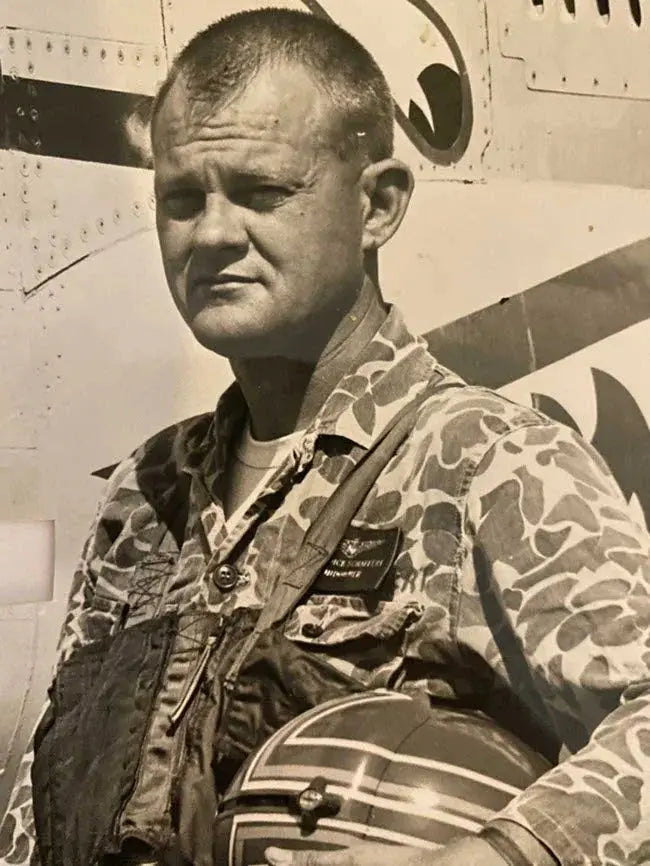
In this post I am going to describe an interesting story about a U.S. Navy pilot by the name of Richard W. Schaffert who served during the Vietnam War on the aircraft carrier USS Oriskany flying Vought F-8C fighter aircraft. Sometimes it is difficult to get a lot of personal information about those who have served in the military, and who have experienced and survived some incredible missions during their service. This is a story of one of them.
Richard W. Schaffert was born on a farm in Nebraska, and after graduation from high school received a scholarship to attend the University of Nebraska. Like so many young men Schaffert enrolled in the ROTC program. Upon graduation Schaffert didn't go straight into service; instead, he took a job as a county extension agent while playing semi-pro baseball.
As fate would have it, on a train trip to California, Schaffert noticed a billboard advertising an event with the Blue Angels, and after some thought Schaffert decided to become a Navy pilot. Despite the fact he had never been in an airplane, he completed his flight training in 1956, winning his Gold Navy Wings.
Next, he qualified aboard the USS Saipan CVL-48 aircraft carrier, followed by a tour flying F-6 Hellcats at Guantanamo Bay, Cuba, then F-11 Tigers off the USS Intrepid, and finally qualiflying in Vought F-8C Crusaders off of the carrier USS Shangri La in the Mediterranean Sea.
Subsequently, Schaffert was transferred to Carrier Air Wing 16 flying Vought F-8C Crusaders off the aircraft carrier USS Oriskany CV-34. On July 8, 1966 the carrier was repositioned to "Yankee Station" in the Gulf of Tonkin, just off the coast of Vietnam.

The USS Oriskany CV-34 underway near Midway Atoll in 1967 enroute to Vietnam.

A U.S. Navy Vought F-8C Crusader of Fighter Squadron (VF-111) is launched from the USS Oriskany (CVA-34).
Vought F-8C Crusader Specifications:
- Crew: One;
- Length: 54 feet 3 inches;
- Wingspan: 35 feet 8 inches;
- Height: 15 feet 9 inches;
- Engine: Pratt & Whitney J57-P-16 17,500 pounds of thrust;
- Maximum Speed: 1,322 mph;
- Service Ceiling: 58,704 feet;
- Range: 522 nautical miles.
During Schaffert's time at "Yankee Station," in the Gulf of Tonkin, several notable events occurred while serving as a fighter pilot in Carrier Air Wing 16 flying the Vought F-8C Crusader aircraft. During his tours he flew 236 combat missions, received 35 decorations, including three Distinguished Flying Cross's "with the Grace of Almighty God."
What follows are two of those most notable events.
October 26, 1966
On the aircraft carrier USS Oriskany pilots shared 6 foot by 9 foot "staterooms" during their cruises. Schaffert shared his stateroom with a fellow pilot by the name of Lt. Cdr. Norman Sidney Levy. The two had become very close friends, and what happened next impacted the rest of Schaffert's life.
On October 26, 1966, both Schaffert and Levy were scheduled for the Alert Five. The "Alert Five" signifies a state of high readiness where specific fighter aircraft and their crews are prepared to launch within five minutes of receiving a launch order.
Because Schaffert had more rest time, he offered to take the Alert Five, and headed to the restroom near the elevator pit. This restroom was close to the flare locker where ordnance men were taking flares out and putting them back as the targets kept changing all the time.
Just as Schaffert finished shaving and started back to the stateroom the ship's loudspeaker began blaring "This is not a drill, this is not a drill, FIRE, FIRE, FIRE!" Schaffert immediately smelled the smoke and looked back at the door between the pilot quarters and the flare storage locker where smoke was coming out from underneath the door.
Schaffert ran back to his quarters and saw Norm Levy sitting on the edge of his bunk and shouted to him "Norm, this is no drill. Let's get the hell out of here!" Schaffert ran down the passageway around the elevator pit banging on walls and shouting "It's no drill! We're on fire! We're on fire!"
Just as Schaffert rounded the corner of that U-shaped passage way the flare locker exploded, sending him out of the passageway and onto the hangar deck. A large ball of fire was rolling along the top of the hangar bay.

October 26, 1966, the USS Oriskany CV-34 is on fire from a magnesium flare explosion killing 44, including his roommate Norm Levy, and injuring Schaffert!
The carrier steamed to Subic Bay in the Philippines where a Flying Tigers 707 transported the dead and wounded, including Norm Levy and Richard Schaffert, back to the United States. By this time the Vietnam War Protests were well underway, and the reception at Lindberg Field was unappreciated, to say the least.
July 18, 1967
Schaffert is once again back on the USS Oriskany, flying missions in his Vought F-8C Crusader fighter jet, over North Vietnam. Because of the distance of the North Vietnamese targets, the F-8C Crusaders need to refuel in order to reach and return from the target area.
The refueling aircraft was the Douglas A-3 Skywarrior, afectionately known as "The Whale" because of it's immense size. Originally designed as a bomber, the Navy found a number of uses for the large aircraft, including working as a tanker to provide fuel for fleet aircraft. This version was known as a Douglas KA-3B Skywarrior.

A Douglas KA-3B Skywarrior aerial refueling an F-8C Crusader over the Gulf of Tonkin, Vietnam.
Douglas KA-3B Specifications:
- Crew: 3;
- Wingspan: 72 feet 6 inches;
- Length: 76 feet 4 inches;
- Height: 22 feet 10 inches;
- Powerplants: Two 12,400 lb. static thrust Pratt & Whitney J57-P-10 turbojets;
- Maximum Takeoff Weight: 82,000 pounds
- Range: 1,290 miles;
- Speed: 620 miles per hour.
On July 18, 1967, the USS Oriskany (CV-34) was sending strike aircraft from Carrier Air Wing 16 'over the beach' deep into North Vietnam to strike bridges located near Phu Ly. At the same time, Lt. Cdr. Tom Maxwell of VAH-4 Detachment Golf was scheduled for a morning tanker hop - another busy day at hand.
Lt. Cdr. Maxwell had flown three tanker flights the day before, logging 7.1 hours of 'green ink' (combat time). This day the CVW-16 aircraft had run into heavy opposition on a morning strike, and Lt. Cdr. Dick Hartman was down and a C-SAR (Combat Search and Rescue) operation was underway to recover him.
By this time Lt. Cdr Dick Schaffert had acquired the nickname 'Brown Bear,' and on July 18, 1967 was flying his VF-111 F-8C Crusader (nickname: 'Old Nick 101'), and as he came off his BARCAP (Barrier Combat Air Patrol) and headed towards Hartman's reported position, he realized another A-4 Skyhawk was down, this one, flown by Lt. Jg Larry Duthie, who had also been hit by 37mm rounds while providing cover for Hartman.
Lt. Jg Duthie could not make it to the coast, so he ejected from his damaged airplane, and he parachuted down to an area near Nam Dinh, North Vietnam. So, now there were two C-SAR operations going on at the same time, roughly 12 miles apart.
Schaffert took on the role of on-scene commander over Duthie, remained in the area, all the time dodging multiple SA-2s (surface-to-air missles), a lot of 37 mm AAA rounds, while his fuel gauge kept getting lower and lower.
Meanwhile, Lt. Cdr. Maxwell amd his crew had landed back on the USS Oriskany. On the deck they stayed in the aircraft while it received a 'hot pump' (refueling with the engines running) in preparation for an immediate launch. While on the deck an intelligence office briefed them on the ongoing Search and Rescue missions.
With the refueling complete, they launched and took up a position about 20 miles off the coast of Vietnam. They continued to monitor the recovery efforts on the SAR radio frequency as helicopters and more aircraft were brought in.
With additional A-4s inbound to relieve Schaffert, he finally turned his Crusader towards the coast, fully realizing he might not make it to the coast, let alone the aircraft carrier, with his low fuel state. In their KA-3B tanker Maxwell and his crew heard Schaffert's Mayday call.
It is important to point out the standing Seventh Fleet orders were that no A-3 Skywarrior would go 'feet dry.' Yet, Maxwell's crew knew if the Crusader didn't get fuel there would be yet another pilot down in North Vietnam.
A quick look around the crew in Maxwell's tanker immediately received a "thumbs up" from the others - Lt. Jg. Jim Vanderhoek and ADJ1 Bill Shelton. There was no need for any more discussion, and Maxwell pushed the Whale's throttles up and they headed for the beach.
With the help of the Red Crown controller (the code name for the Positive Indentification Radar Advisory Zone) who provided US aircraft with radar coverage while over North Vietnam via ship-mounted air search radar, Maxwell flew inland between 30 and 40 miles.
Spotting Schaffert's F-8C Crusader, Maxwell made a hard right turn in front of Schaffert's airplane while his B/N (Bombardier/Navigator) extended the refueling basket. While all of this was going on there were flak bursts nearby and the crew's SAM warning horns blared in their ears, indicating active SAM sites in the area.
Schaffert saw the Whale turn in front of him and made a hot approach to the basket with his refueling probe, connecting on the first try, and watching thankfully as his fuel gauges went up as JP-5 jet fuel replaced the air in the Crusader's fuel tanks. The pair stayed plugged in almost all the way to the coast while Schaffert's Crusader took on over 1,200 gallons of fuel.
The USS Oriskany was ready for them, and both aircraft trapped successfully on the first try. The Whale crew logged 3.1 hours of combat time for their morning's work. The saving of Lt. Cdr. Schaffert was unfortunately the only successful operation this day.
Other than the rescue of Schaffert, it was a very grim day for CVW-16. A 'Big Mother" SH-3A helicopter with four crewman was lost tyring to recover Hartman on the 19th. Yet another A-4 was lost when struck by AAA and the pilot had to eject over the water, but being recovered. Hartman was captured and died in captivity, but Duthie was eventually recovered by a USAF HH-3E "Jolly Green Giant."
Ironically, Maxwell and his crew received no official recognition of their bravery, since they had violated Seventh Fleet orders. They did, however, receive the undying gratitude of the other members of CVW-16.
I hope you enjoyed this trip through some of the history of aviation. If you enjoyed this trip, and if you are new to this newsletter, sign up to receive your own weekly newsletter here: Subscribe here!
Until next time, keep your eyes safe and focused on what's ahead of you, Hersch!



Written by John M. White


Search this site
Recent Posts
-
The Perfect Gift Ideas for Pilots: From Sunglasses to Aircraft Models
October 03, 2026 -
Why Are Aircraft Wood Models Popular Among Collectors?
October 03, 2026 -
Jimmie Angel, Aviator, Explorer, Prospector
September 19, 2026 -
Imagine Finding Yourself In A Freefall from 28,000 Feet!
July 31, 2026

Leave a comment
This site is protected by hCaptcha and the hCaptcha Privacy Policy and Terms of Service apply.