
High Altitude UV Eye Protection: What Actually Works
Quick Summary
High altitude UV exposure rises because the atmosphere filters less radiation at elevation, and snow, ice and water reflect it back toward your face. Effective protection needs lenses that block 99 to 100% of UVA and UVB, ideally marked UV400, plus wraparound frames or side shields.
- Look for lenses that block 99 to 100% of UVA and UVB, ideally marked UV400.
- Darkness and UV blocking are separate: a dark tint without UV treatment is worse than none.
- Category 3 suits most bright-sun outdoor use; Category 4 is for extreme glare on glaciers and snow.
- Wraparound frames or side shields cut reflected UV from the sides and below.
- Seek medical care for eye pain, light sensitivity or blurred vision after time at altitude.
Table of Contents
- Why UV Exposure Climbs With Altitude
- Snow, Ice and Reflected UV: The Hidden Multiplier
- Photokeratitis and Snow Blindness: What Happens to the Eye
- Best High Altitude UV Eye Protection: Lens Standards to Check
- High Altitude UV Protection Glasses: Frames, Coverage and Side Shields
- Glacier Glasses and Why Mountaineers Wear Dark Goggles
- Polarized Sunglasses for Pilots and Cockpit Use
- Protecting Children, Light-Sensitive Eyes and Prescription Wearers
- Choosing Your Next Pair: Fit, Care and When to Replace
- Frequently Asked Questions
Why UV Exposure Climbs With Altitude
High altitude UV eye protection matters because ultraviolet radiation gets stronger the higher you climb. The atmosphere filters less of it at elevation, so the sun's rays reach your eyes with greater intensity than they do at sea level.
Solar altitude changes the picture too. A study on UV-B exposure to the eye depending on solar altitude reported that higher solar altitude was associated with higher UVR exposure in the condition facing away from the sun, although the overall level was lower H. Sasaki et al., UV-B exposure to the eye depending on solar altitude. That finding means exposure is not simply a matter of looking toward the sun. Your eyes receive UV from many angles, and the geometry of your surroundings matters.
Elevation adds other stressors. The University of North Carolina Department of Ophthalmology warns that high elevation, severe cold, and dry weather increase snow-blindness risk for skiers and snowboarders UNC Department of Ophthalmology, July is UV Eye Safety Month. Those conditions often arrive together, which is why eye protection at height deserves more attention than many people give it.
Snow, Ice and Reflected UV: The Hidden Multiplier
Direct sunlight is only part of the problem. Snow, ice and water reflect UV back toward your face, so you receive exposure from below as well as from above. Glacier travel, skiing and open-water flying all combine high elevation with reflective surfaces.
UCI Health says wraparound sunglasses or goggles are important at high elevations because UV exposure is more intense, and around snow and water UCI Health, Preventing sun damage to your eyes. Reflected light reaches the eye from angles that a simple brow-level frame does not cover, which is where side shields and curved lenses earn their place.
Photokeratitis and Snow Blindness: What Happens to the Eye
Photokeratitis is a painful inflammation of the cornea caused by UV exposure. Snow blindness is the common name for this condition when it follows time on bright snow or ice. Symptoms typically appear hours after exposure, which is why people often do not connect the discomfort to their day outdoors.
The American Academy of Ophthalmology recommends sunglasses or goggles that block at least 99% of UV rays, and notes that protection from dry, freezing wind helps prevent snow blindness American Academy of Ophthalmology, eye safety guidance. If you experience eye pain, light sensitivity or blurred vision after time at altitude, seek medical care rather than waiting for the symptoms to pass.
Best High Altitude UV Eye Protection: Lens Standards to Check
Good high altitude UV eye protection starts with the lens specification, not the frame style. Two numbers matter, and they are not the same thing: the UV-blocking rating and the visible light transmission (VLT) of the tint. Confusing them is the most common buying mistake at altitude.
UVA and UVB Coverage, and What UV400 Means
Effective eyewear should block both UVA and UVB. The American Optometric Association recommendation, cited by the Federal Aviation Administration, is 99 to 100% UVA and UVB protection Federal Aviation Administration, Sunglasses for Pilots: Beyond the Image. The UV400 label indicates protection up to 400 nanometres, which covers the full UVA and UVB range. When a product states this clearly, you can compare it directly against that benchmark.
A lens can be nearly clear and still block 100% of UV, or deeply tinted and block almost none. UV blocking comes from the lens material and its treatment, not from how dark it looks. That is why a cheap dark lens is a worse choice than a lightly tinted lens with a verified UV400 rating.
Lens Categories and Visible Light Transmission
European and many international standards sort sunglass lenses into filter categories based on how much visible light they let through. The categories are a useful shorthand for matching a lens to conditions, and they are separate from the UV rating:
- Category 0: roughly 80-100% VLT, clear or very light tints, for indoor or low-light use, not for bright sun.
- Category 1: roughly 43-80% VLT, light tint for overcast or early/late-day conditions.
- Category 2: roughly 18-43% VLT, a general-purpose tint for moderate sun.
- Category 3: roughly 8-18% VLT, the standard bright-sun lens for most outdoor sport.
- Category 4: roughly 3-8% VLT, very dark lenses for extreme glare, such as high glaciers and high-altitude snow.
For high-altitude snow and glacier travel, Category 3 is the everyday workhorse and Category 4 is the specialist choice for sustained glare. Category 4 lenses are usually too dark for driving and are unsuitable for road use in many jurisdictions, so treat them as activity-specific rather than all-purpose.
Watch out: a Category 4 lens with no UV400 marking gives you darkness without protection, the tint widens your pupils while the lens lets UV through, which is worse than wearing nothing.
Lens Darkness Versus Real UV Protection
A darker tint does not mean better UV protection. A deep lens can make your pupils open wider, letting more light and potentially more UV reach the eye if the lens itself lacks UV-blocking treatment. Choose the protection level first, then select a tint that suits your light conditions.
Tint Colour and Glare Management
Tint colour affects contrast and glare perception, not UV blocking. Grey tints keep colours relatively natural and suit general alpine use. Brown and copper tints warm the view and can sharpen contrast on snow, which many skiers prefer in flat light. Green tints sit between the two. Mirror coatings cut visible light and glare but add no UV protection of their own, the UV rating still has to come from the lens itself. Polarization is a separate feature again: it kills glare off snow and water but can interfere with LCD screens and some aircraft instruments, so it is a comfort and task choice rather than a safety requirement.
The article sets out the lens categories and what each one is for, which makes a quick reference for matching a lens to conditions.
| Category | Visible light transmission | Best for |
|---|---|---|
| Category 0 | 80-100% | Indoor or low-light use, not bright sun |
| Category 1 | 43-80% | Overcast or early and late-day conditions |
| Category 2 | 18-43% | General-purpose tint for moderate sun |
| Category 3 | 8-18% | Standard bright-sun lens for most outdoor sport |
| Category 4 | 3-8% | Extreme glare on high glaciers and snow |
Visible light transmission
High Altitude UV Protection Glasses: Frames, Coverage and Side Shields
Frame design determines how much reflected and peripheral UV reaches your eyes. Wraparound frames and side shields reduce exposure from the sides and below, which matters most on snow, water and aircraft windows. Check the fit of the temples as well, particularly if you wear a headset, because discomfort over long periods leads people to take eyewear off at the wrong moment. Learn how cockpit UV exposure is shaped by fit and aircraft windows.
Glacier Glasses and Why Mountaineers Wear Dark Goggles
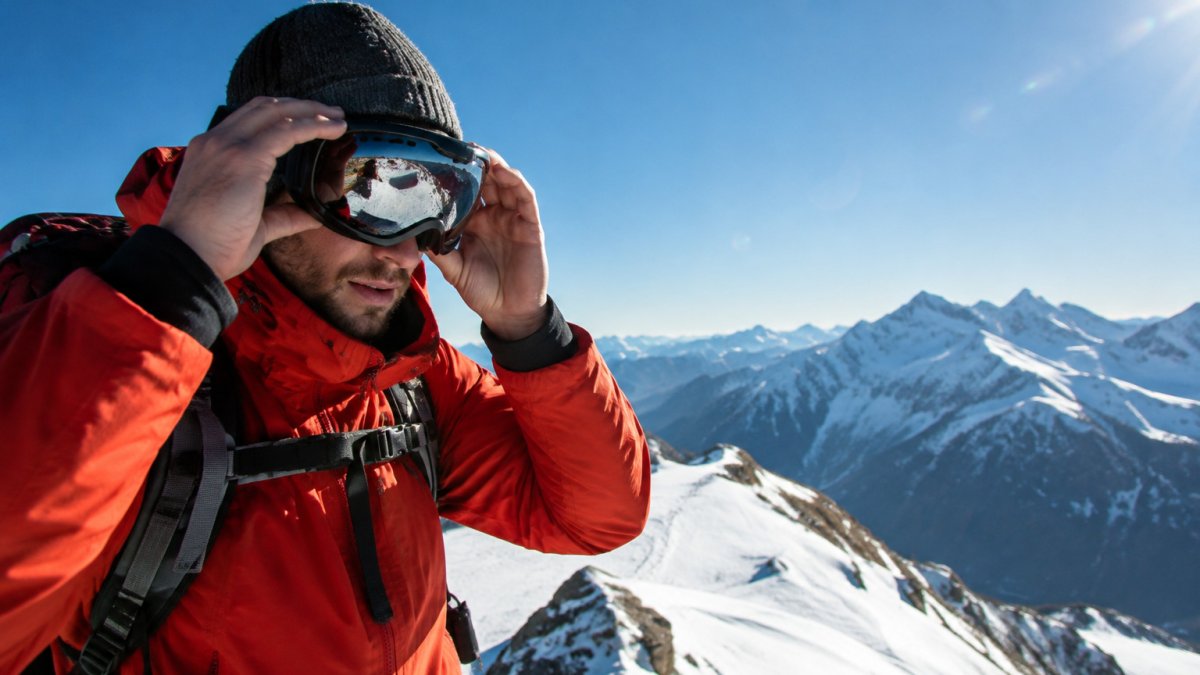
Glacier glasses are a traditional style for mountaineering and glacier travel. See a full-frame dark-tinted option. They typically feature dark tints and full side coverage, designed to shield the eyes across snow fields and ice where reflection is intense. For glacier travel specifically, dark wraparound eyewear with verified UV blocking remains the standard choice. Their full-frame design leaves little gap for reflected light to enter, which is the core reason mountaineers rely on them.

Polarized Sunglasses for Pilots and Cockpit Use
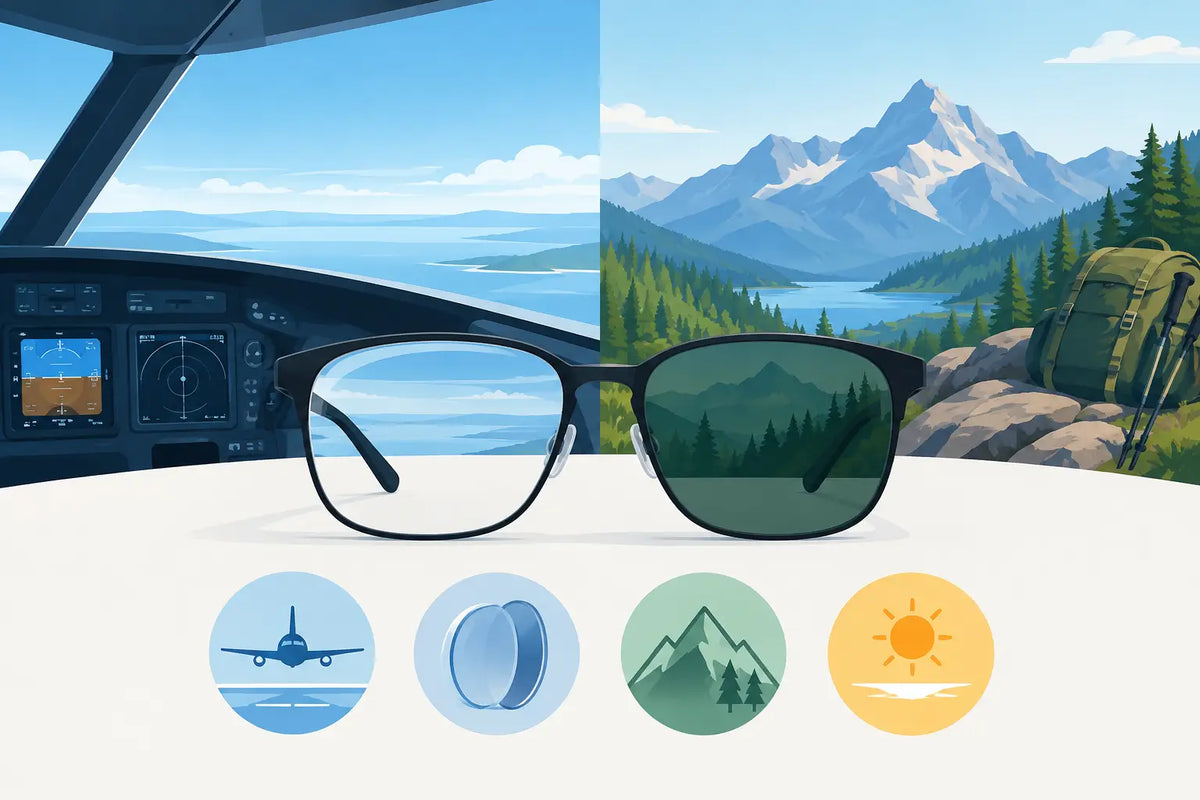
Polarization reduces glare, but it is not always the right choice in the cockpit. Non-polarized lenses are generally recommended for pilots, because polarized lenses can interfere with reading LCD cockpit instruments and make it harder to see other aircraft. Polarized lenses suit driving, boating and fishing, where glare off water or road surfaces is the main concern.
Protecting Children, Light-Sensitive Eyes and Prescription Wearers
General outdoor eyewear advice assumes an adult with average eyes and no corrective lenses. At altitude, three groups need different answers: children, people with light sensitivity or eye conditions, and anyone who wears prescription glasses or contact lenses.
Children at Altitude
Children's eyes transmit more UV than adult eyes, and young people typically spend more time outdoors, so protective eyewear is worth prioritising rather than treating as an afterthought. The practical problem is fit: adult frames slide, gap at the temples, and get pushed up the nose, which opens exactly the side and lower coverage that reflected snow light exploits. Look for child-specific frames with a close wrap, a strap or grippy temples, and a verified UV400 rating. For very young children on snow, a small goggle with a strap often stays in place better than sunglasses. Model the behaviour too, children are far more likely to keep eyewear on if the adults around them are wearing it.
Light Sensitivity and Eye Conditions
People with light sensitivity, and those with conditions such as albinism, macular degeneration, or a history of photokeratitis, may need darker lenses and fuller coverage than a standard Category 3 sunglass. Some medications and eye conditions also increase sensitivity to light. This is a case for an eye care professional rather than a generic product recommendation: the right lens category and any tint or coating choice should follow an assessment, not a guess from a product page.
Prescription Wearers
Prescription users have three realistic routes at altitude:
- Prescription sunglasses: UV-protective lenses ground to your prescription in a wrapped or shielded frame. This gives the best combination of correction and coverage, but strongly curved frames limit the prescription range that labs can fit.
- Fitover eyewear: a UV-protective shield that wears over your regular glasses. Cheap and effective for occasional use, though heavier and prone to fogging.
- Prescription inserts in goggles: common for skiing and mountaineering, where an optical insert clips inside the goggle.
Watch out: ordinary contact lenses do not replace protective eyewear. Some contacts carry UV blocking, but they cover only the cornea and leave the surrounding eye, eyelids, and sides exposed, at altitude you still need sunglasses or goggles with side coverage over them.
Getting the Fit Right
Whichever route you take, check coverage the same way: look up, down, and to the side and confirm the lens still covers the eye, and confirm the frame sits close at the temples without pressing. A prescription frame that fits well at sea level may gap badly under a helmet or with a headset, so test it with the rest of your kit before you rely on it.
Choosing Your Next Pair: Fit, Care and When to Replace
Start with the UV specification, then check fit. Read a guide to choosing tints, coatings and headset fit for high-altitude use. The lens should cover your eye fully when you look up, down and to the side. Test the temples with any headset you use, and wear the glasses for a sustained period before committing.
Clean lenses with a soft cloth and avoid abrasive materials, since scratched lenses reduce optical clarity. Replace eyewear when lenses are visibly damaged, when the coating wears away, or when the frame no longer sits securely.
Last Updated: November 7, 2026
Ready to find the right pair? Aviator Sunglasses curates eyewear for pilots, veterans and outdoor enthusiasts, with cockpit-tested options and personal guidance from a USAF veteran and former ATP corporate pilot. Sign up to explore the range.
Frequently Asked Questions
Do you get more UV exposure at higher altitude?
Yes. Solar UV intensity increases as elevation rises because there is less atmosphere to filter it. A 2011 study on UV-B exposure and solar altitude found that higher solar altitude was associated with greater UV exposure, although overall levels were lower. The University of North Carolina Department of Ophthalmology also warns that high elevation, severe cold and dry weather raise snow-blindness risk for skiers and snowboarders. Eye protection that blocks UVA and UVB is the practical response, whatever the season.
What blocks 100% of UV rays?
Lenses labelled as blocking 100% of UVA and UVB, often marked UV400, block essentially all ultraviolet light up to 400 nm. The American Academy of Ophthalmology recommends sunglasses or goggles that block at least 99% of UV rays. Darkness of the tint does not indicate UV protection, since a light tint can offer full protection and a dark tint can offer none. Check the label or the manufacturer's specification rather than relying on colour.
How can you protect your eyes from snow blindness?
Wear wraparound sunglasses or goggles with UVA and UVB protection whenever you are above the snowline or on snow or ice. Side coverage matters because reflected UV reaches the eye from below and from the sides. Dry, freezing wind also contributes to snow blindness, so goggles or close-fitting frames help. If symptoms such as gritty pain, light sensitivity or blurred vision appear after exposure, seek medical care promptly rather than waiting for them to pass.
Are polarized sunglasses suitable for high-altitude activities?
Polarized lenses reduce glare from snow, ice and water, which suits skiing, hiking and boating. However, polarization is separate from UV protection, so confirm UVA and UVB blocking on the label. For pilots, polarized lenses can interfere with reading LCD cockpit instruments and make it harder to see other aircraft, so non-polarized lenses are generally recommended in the cockpit. Aviator Sunglasses lists its AO General and AO Original Pilot styles as non-polarized for this reason.
What features should glacier glasses have?
Glacier glasses should block 100% of UVA and UVB, offer wraparound or side-shielded coverage, and fit snugly so that reflected light cannot enter from the edges. Lens darkness should suit the light conditions, with a darker tint used in bright snow. Impact resistance also matters on rough terrain. Frames should stay secure during movement and sit comfortably over any face covering or helmet strap used on the route.
Do you need eye protection on cloudy days at high altitude?
Yes. Clouds diffuse sunlight but do not block UV reliably, and snow can reflect a significant share of UV even under overcast skies. The UC Irvine Health guidance on high-elevation eye protection notes that UV exposure is more intense at altitude and around snow and water. Keeping UV-blocking eyewear with you on cloudy high-altitude days is a sensible precaution.
Why do mountaineers wear dark goggles?
Mountaineers wear dark goggles to limit both UV exposure and the intense visible glare reflected from snow and ice. Reducing glare helps with depth perception and sustained concentration on rough terrain. The darkest lenses are chosen for sunny, high-glare conditions and paired with side protection. UV-blocking performance should be verified on the label, because darkness alone does not guarantee protection.
Do pilots need UV protection in the cockpit?
Aviation guidance treats UV protection as a core consideration for pilots. Eyewear that blocks both UVA and UVB is the benchmark to look for. Pilots should choose non-polarized lenses for cockpit instrument reading, and frames that fit under a headset. Aviator Sunglasses, founded by a USAF veteran and former ATP corporate pilot, curates AO eyewear with these considerations in mind.


Search this site
Recent Posts
-
The Lost Squadron: How a P-38 Spent 50 Years Under Greenland's Ice
November 06, 2026 -
The Perfect Gift Ideas for Pilots: From Sunglasses to Aircraft Models
October 03, 2026 -
Why Are Aircraft Wood Models Popular Among Collectors?
October 03, 2026 -
Jimmie Angel, Aviator, Explorer, Prospector
September 19, 2026

Leave a comment
This site is protected by hCaptcha and the hCaptcha Privacy Policy and Terms of Service apply.